
Key takeaways
- Physics-informed AI integrates physical laws directly into neural networks to ensure predictions remain grounded in reality.
- The new model reduces wind simulation times from hours to seconds, allowing for rapid iteration in site planning.
- By accurately modeling wind flow around obstacles, the AI helps maximize energy output for wind farms.
- While highly efficient, the model still requires traditional verification for extreme weather scenarios.
Imagine trying to predict exactly how a gust of wind swirls around a massive, rotating turbine blade. Standard computer simulations often take hours or even days to calculate these complex turbulent flows, requiring massive supercomputing power to get it right. We are seeing a significant shift in how we approach this engineering bottleneck. By using physics-informed ai for wind energy, researchers are moving away from pure, brute-force number crunching toward models that actually respect the fundamental laws of fluid dynamics.
In this piece, we explore how physics-informed neural networks are turning academic theory into practical infrastructure. We look at the latest work from institutions like Sandia National Laboratories, as reported by bioengineer.org, to see how we can speed up simulations while maintaining accuracy. Much like how we have explored AI Face Scan to Detect Health: Transforming Rural Healthcare, the goal here is to make high-level science practical for real-world energy production. Let’s break down how this technology works.
The Computational Bottleneck in Fluid Dynamics
Traditional Computational Fluid Dynamics (CFD) is the bedrock of wind energy engineering, but it’s struggling to keep pace. If you want to simulate how wind moves over a complex, hilly landscape, CFD breaks space into millions of tiny cells. It then calculates the physics of airflow for every single one. On a standard high-performance computer, this isn’t just a quick check—it’s a marathon that can take days.
Engineers are constantly stuck in a frustrating trade-off. You can run a low-resolution simulation that finishes in minutes, but you’ll miss the turbulent details that actually damage turbine blades. Or, you can aim for high-resolution accuracy, which delivers the data you need but stalls progress by forcing you to wait hours for a single result.
Historically, we’ve relied on rules-based modeling, where you manually feed strict physical equations into a machine. Conversely, pure data-driven modeling learns entirely from patterns in historical wind logs. Neither approach is perfect on its own. This is exactly where physics-informed ai for wind energy changes the conversation. By merging these two worlds, we can finally bypass the massive supercomputing bottlenecks. Just remember, as we integrate more data, you should also look into Secure Prompt Engineering Practices: Protecting Your AI Data to keep your proprietary energy models safe.
How Physics-Informed AI Learns the Rules of Wind
Standard AI models often act like black boxes, treating wind simply as a pattern-matching task. If you feed such a model images of a mountain and wind speed, it tries to guess the result based on past pictures without understanding the underlying science. Physics-informed AI for wind energy takes a different approach: it knows the rules of the game.
When we ask what is physics-informed ai, we’re talking about embedding fundamental scientific principles—such as the Navier-Stokes equations—directly into the model’s loss function. Think of it as a built-in reality check. If the model suggests wind could pass through a solid hillside or move in a way that defies mass conservation, the math rejects that path immediately.
Instead of treating a gust as a lonely data point, the system treats wind as an interconnected fluid dynamic. During training, the AI effectively learns to "see" around obstacles. By forcing the model to respect physical constraints, it builds a structural understanding of how air flow changes behind a turbine or a hill. This is exactly why companies are betting on these methods to manage complex energy grids, as seen in the recent partnership between Applied Computing and Wipro finance.yahoo.com. The result is a model that doesn’t just guess; it reasons within the boundaries of our known universe.
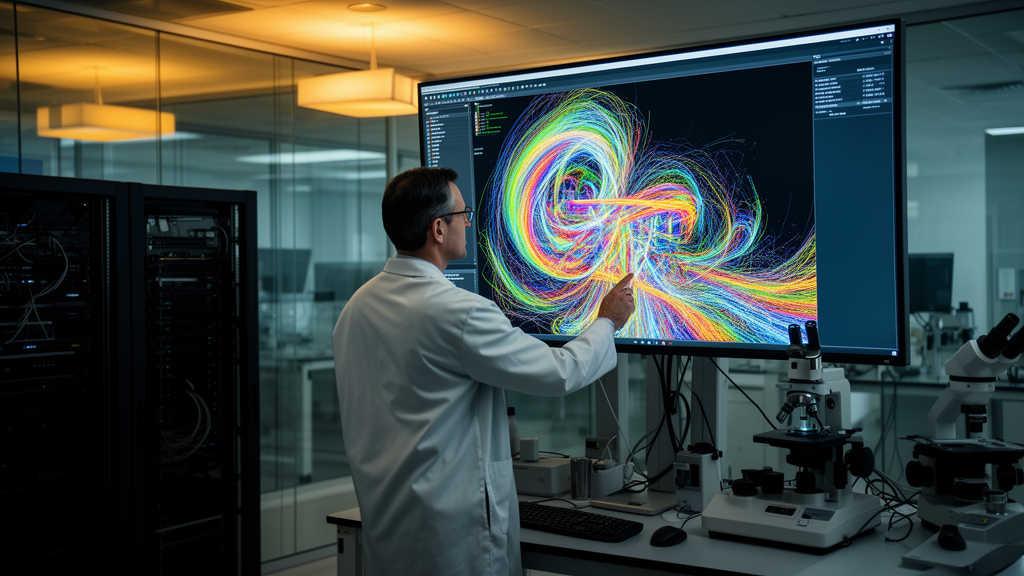
Speeding Up Simulation: Seconds vs. Hours
Traditional fluid dynamics simulations are notoriously slow. Running a high-fidelity model to predict how wind flows through a turbine array often requires hours or even days of processing time on massive supercomputer clusters. This creates a significant bottleneck when you are trying to test dozens of layout variations for a new wind farm.
Physics-informed AI changes the math of this bottleneck. While the initial training phase is resource-intensive, the resulting model can perform inference in seconds. Once the neural network has learned the fundamental physical laws governing turbulence, it no longer needs to solve every individual equation from scratch for each scenario.
This shift means engineers can iterate through designs on standard hardware, such as a powerful workstation or a cloud-based instance, rather than waiting in a queue for a dedicated supercomputing cluster. Much like how AI in DNA Analysis: What Hugging Face’s DNA Model Means for Gene Therapy uses learned patterns to accelerate biological sequencing, these models use physics-constrained patterns to predict wind behavior. By drastically reducing the time-to-result, designers can optimize turbine placement for maximum energy yield, testing hundreds of configurations before breaking ground—a practical advantage that was previously impossible.
Optimizing Turbine Placement for Maximum Yield
If you’ve ever watched a wind turbine, you might think it’s just about catching a breeze. In reality, it’s about managing the "wake effect"—the turbulent, slower air that trails behind every spinning blade. If you place a second turbine too close in that wake, it loses significant efficiency. It’s like standing behind a fan; you aren’t getting the same airflow as the person in front.
Physics-informed AI for wind energy changes the math here. By embedding physical laws directly into the model, AI can predict exactly how wind behaves as it hits hills or valleys. This allows for optimizing turbine placement with AI by identifying patterns that minimize this "shadow" effect. Instead of relying on expensive, slow simulations, developers can now run high-fidelity tests rapidly.
Imagine you are a project developer evaluating a new site in the Western Ghats. You need to test 100 different turbine configurations to see which layout captures the most energy without causing excessive wear. With this AI, you can run those 100 simulations in a single day, a feat that previously took weeks. This speed isn’t just a technical win; it translates to lower development costs and smarter infrastructure, similar to how businesswire.com uses physics-informed platforms to accelerate energy tech.

The Role of Training Data in Physical Modeling
Unlike large language models that feast on the chaotic sprawl of internet text, physics-informed AI for wind energy demands something far more precise. You cannot simply train a model on random web snippets and expect it to understand complex turbulent flows. Instead, these systems rely on high-fidelity, synthetic physical data generated from rigorous computational fluid dynamics simulations.
Think of it this way: LLMs aim for linguistic probability, while this AI aims for the strict conservation of mass and momentum. If you feed it messy, unverified internet data, the entire simulation fails. You need controlled, simulated datasets—like the foundation models MATEY or those developed for the Department of Energy’s Genesis Mission—that act as a bedrock of reality. Just as you wouldn’t want a faulty connection interfering with your hardware (check this USB-C Cable Checklist: Charge, Data, and When to Replace if you are curious about data integrity), you cannot use sloppy, unconstrained data for wind turbine optimization.
The real challenge appears during edge cases, such as extreme weather events. To prevent the model from "hallucinating" non-physical outcomes, researchers employ Bayesian methodologies like B-ODIL. This process forces the AI to cross-reference its predictions against known physical laws. If a result violates energy conservation constants, the system flags the error, ensuring the model stays grounded in reality rather than drifting into fiction.
Broader Applications: Beyond Wind Turbines
The mechanics behind physics-informed ai for wind energy are not staying in the fields. Because these models focus on turbulent flow—the chaotic, unpredictable movement of air—they have massive potential for urban environments. Imagine architects simulating how wind moves between skyscrapers to combat urban heat islands. By integrating these models into building ventilation designs, we could naturally cool homes, significantly reducing the reliance on air conditioning in hot, dense cities like Delhi or Mumbai.
The same logic applies to aerospace engineering. Engineers designing next-generation vehicles or aircraft currently spend weeks running high-fidelity simulations to cut drag and improve fuel efficiency. With a foundation model capable of handling complex fluid dynamics, those design cycles could shrink dramatically. As noted by bioengineer.org, the objective is to build a versatile tool that adapts to different physical problems rather than one narrow task.
Beyond design, this technology could change how we manage energy grids. If we can predict wind shifts with high accuracy in real-time, grid operators can balance loads more efficiently, knowing exactly when to draw power from wind farms. Even weather forecasting stands to gain; by refining how we model microscopic aerosol interactions in the atmosphere, these systems will eventually provide more precise, hyper-local forecasts. It is simply about teaching computers the physics of the air, whether it is flowing over a turbine blade or a city block.

Current Limitations and Reliability
Even if these models look promising, they aren’t ready to run a power grid solo. Physics-informed AI struggles when it hits edge cases, like extreme storms or unusual atmospheric turbulence that fall outside its training data. Unlike stable, predictable airflows, these chaotic events can cause an AI to hallucinate physics, leading to dangerous errors in turbine load calculations.
Engineers are rightly cautious about the "black box" nature of neural networks. While we might use advanced algorithms to solve biological puzzles—like in AI Anti-Ageing Research: How We Can Eliminate ‘Zombie Cells’—energy infrastructure requires a higher bar for accountability. A mistake in a turbine placement model could cost millions or lead to structural failure.
The current solution isn’t replacing traditional solvers but creating hybrid systems. In these setups, the AI provides a fast, initial estimate, which is then validated by conventional computational fluid dynamics software. Today, these projects, such as the Department of Energy-funded Genesis Mission, remain firmly in the research prototype phase. We have the framework, but we lack the industry-wide verification needed to call this production-ready. Don’t expect to see these tools running full-scale wind farms just yet; think of them as an expert’s high-speed drafting pencil, not the final blueprint.
The Future of Energy Infrastructure
As these tools mature, the long-term impact on renewable projects could be massive. Currently, the high cost of engineering—especially the compute time required to model turbulent airflow—acts as a barrier for many developers. By shrinking simulation times from days to mere seconds, companies can drastically lower their pre-construction overhead. This efficiency is critical for hitting global net-zero targets; when you place turbines exactly where they capture the most kinetic energy, you generate more power without building more infrastructure.
Accessibility is also improving. Strategic collaborations, such as the partnership between Applied Computing and Wipro, suggest that industrial-grade physics-informed AI for wind energy will soon move from elite research labs into the hands of smaller firms and universities. This democratization allows regional developers to optimize wind turbine placement with AI, even on tighter budgets.
The next major hurdle for researchers is scaling. Moving beyond localized turbine clusters, the goal is to integrate these models into global weather pattern simulations. If we can reliably predict how a massive storm system interacts with a coastal wind farm, we can adjust turbine settings in real-time to prevent mechanical strain. It’s a shift from static planning to a living, reactive energy grid.
Frequently Asked Questions
What is the difference between standard AI and physics-informed AI?
Standard AI identifies patterns in data by looking at inputs and outputs, often ignoring physical reality. Physics-informed AI, like the Sandia-led project, embeds known physical laws—such as fluid dynamics equations—directly into its training process. This ensures the output remains grounded in reality, providing a model that understands how wind flows rather than just guessing based on past observations.
Can this AI model replace traditional wind tunnel testing?
Currently, no. While research into physics-informed neural networks for wind energy is moving quickly, wind tunnels remain the primary benchmark for validation. Instead of replacing physical labs, AI serves as an efficient screening tool. It helps engineers test thousands of turbine placement configurations in seconds, narrowing down the best options before moving to the expensive and time-consuming physical testing phase.
Does this technology require expensive supercomputers to run?
Training these models often requires massive computing power, such as the resources provided by the Department of Energy’s Genesis Mission. However, the end goal is efficiency. Once a foundation model is fully trained, it can potentially run on smaller hardware to provide rapid predictions. This is a significant shift from the hours of computation currently needed for traditional, high-fidelity wind turbine simulations.
How accurate are AI-generated wind predictions compared to human-led simulations?
Accuracy remains a critical area of research. Experts like those at Sandia are currently focused on quantifying uncertainty, which is a major hurdle for AI. While human-led simulations using traditional Computational Fluid Dynamics are still considered the gold standard for reliability, AI aims to provide a comparable speed boost without sacrificing the physical accuracy required for large-scale energy infrastructure projects.
Beyond the Hype: The Reality Check for AI Energy Models
While physics-informed AI for wind energy promises to slash simulation times, we aren’t quite at the finish line yet. As researchers from Sandia and Harvard point out, the biggest hurdle remains quantifying uncertainty. Can we truly trust an AI to accurately model a sudden, violent gust that could damage a turbine? It is a challenge similar to the complexity we’ve seen in other deep scientific problems, such as How AI Solved the KLS Conjecture: Inside the 31-Year Math Breakthrough.
The Department of Energy-funded Genesis Mission is still in the developmental phase. We do not yet have validated benchmarks confirming that these models consistently outperform traditional, high-fidelity fluid dynamics simulations. If you work in energy infrastructure, don’t ditch your conventional software just yet. Keep an eye on how these Bayesian methods evolve, as the real test will be their performance in the unpredictable, messy reality of a wind farm.
Sources and further reading
- Sandia-Led AI Project Targets Uncertainty in Turbulent Flow Models — bioengineer.org
- Alsym Energy Announces Na-Series Battery Success Developed With Physics-Informed AI Platform — businesswire.com
- Applied Computing forges strategic partnership with Wipro and Databricks to accelerate the energy transition through physics-informed AI — finance.yahoo.com


Join the conversation