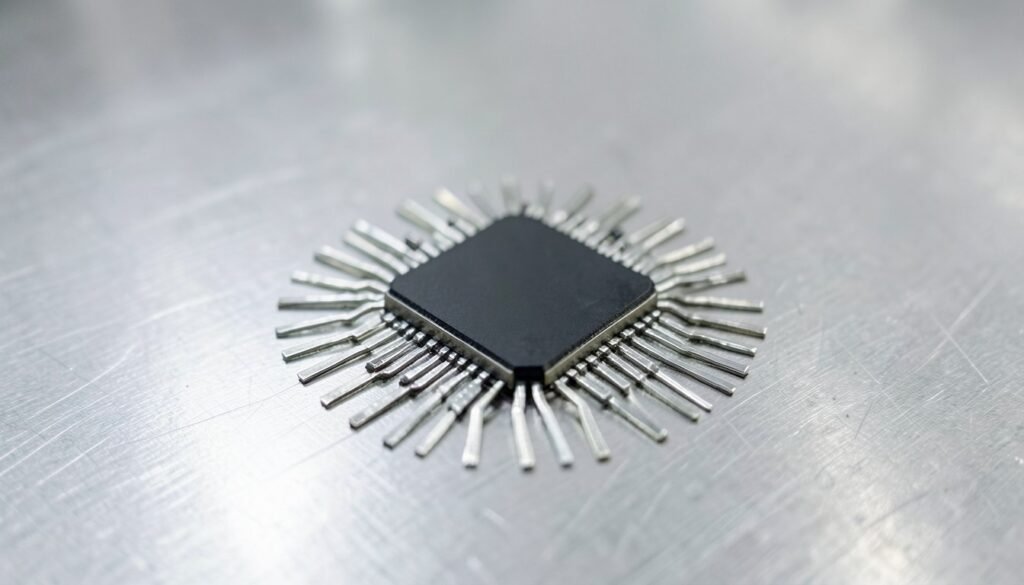
Key takeaways
- Brown University researchers have developed a hardware design that significantly reduces the power required for AI processing.
- The architecture uses neuromorphic principles to process data only when necessary, mimicking biological brain efficiency.
- Transitioning to these chips could drastically lower the carbon footprint of large-scale AI data centers.
- The primary hurdle remains the integration of these new designs into existing software ecosystems and manufacturing processes.
Imagine a data center so power-hungry it makes a small city’s grid tremble. That is the reality of modern AI infrastructure, where the bottleneck isn’t just raw computing power—it is the electricity bill. Lately, I have been watching a fascinating shift: engineers are moving away from just training massive models toward perfecting the most energy efficient ai chips. As siliconangle.com reports, startups are already securing massive funding to tackle this exact power crisis.
In this piece, we will explore how researchers at Brown University and others are rethinking hardware from the transistor level up. It is a shift as critical as Physics-Informed AI for Wind Energy: Optimizing Turbine Placement. We will examine how neuromorphic designs and flexible architectures aim to mimic the human brain to stop wasting energy on data movement, helping you understand how AI chips work and why the next generation of hardware will define our sustainable future.
The Hidden Energy Cost of Modern AI
Training a large language model today consumes enough electricity to power entire neighborhoods for weeks. It’s not just the training; it’s the constant, silent hum of billions of inferences happening every second. Current GPU architectures, which have been the workhorses of this boom, are hitting a hard thermal and power ceiling. They were designed for rendering pixels, not for the massive, iterative matrix math required by modern AI models.
This is why we’re seeing such a desperate hunt for the most energy efficient ai chips. When you look at how ai chips work, the bottleneck isn’t usually the logic gates themselves, but the energy wasted moving data across the silicon. We’ve reached a point where data center cooling systems are stretched to their limits, struggling to keep up with the heat generated by these power-hungry processors.
The industry is shifting its focus to "power-per-inference"—the true metric for success. It’s no longer just about raw speed; it’s about how much intelligence you get for every watt burned. This transition in AI hardware efficiency is critical because data centers now account for a significant, and growing, percentage of global electricity consumption. If we don’t optimize our silicon, we’ll run out of headroom for progress. This efficiency isn’t just about saving pennies on the electricity bill; it’s about enabling breakthroughs in complex fields like AI in DNA Analysis: What Hugging Face’s DNA Model Means for Gene Therapy without burning through the planet’s resources.
The Brown University Breakthrough: A New Approach
Most modern processors are trapped by the von Neumann bottleneck, a decades-old architecture that forces data to shuffle constantly between a central processing unit and external memory. This "data tax"—the energy spent just moving bits around—is what kills your battery and heats up the data center.
Engineers at Brown University are challenging this status quo by rethinking the fundamental physical layout of the chip. Instead of a rigid, general-purpose design, their approach integrates processing power directly into the memory structure. By using non-traditional circuit layouts, they allow computations to happen where the data actually lives, rather than shuttling it back and forth through a memory bus.
This shift is essential for AI hardware efficiency. While standard GPUs burn massive amounts of power just to keep the data moving, this new architecture minimizes these transitions, which often account for the lion’s share of energy consumption. As noted in research on flexible neural processing units, reducing this movement is the key to creating the most energy efficient ai chips. By avoiding the constant energy drain of the traditional memory-processor divide, these chips can perform complex neural network operations with a fraction of the power, offering a sustainable path forward that rigid, older designs simply cannot match.

Neuromorphic Design: Mimicking the Human Brain
What neuromorphic computing means
Neuromorphic chips try to copy the brain’s wiring instead of forcing every operation into a giant matrix. Think of a tiny city of artificial neurons that fire only when they receive a meaningful signal, just like the 30 Hz spikes you see in cortical recordings. The architecture replaces the usual clock‑driven pipeline with asynchronous circuits that react to incoming events.
Spike‑based processing vs. continuous streams
Traditional AI accelerators push dense tensors through every layer on every clock tick, even if most of the values are zero. A neuromorphic processor, by contrast, represents data as spikes—binary pulses that travel along synaptic connections only when the underlying activation crosses a threshold. If a neuron stays silent, no electricity is spent moving its value. This “event‑driven” mode cuts idle power dramatically; FuriosaAI’s Tensor Contraction Processor already shows half the wattage of a comparable GPU, and neuromorphic designs can push that reduction even further.
Energy benefit of event‑driven operation
Because energy is proportional to the number of spikes, a network that is 90 % sparse can operate on a fraction of the power needed for dense inference. In laboratory measurements reported by Unconventional AI, their analog‑based chip claimed up to 1,000× better energy efficiency than Nvidia’s GPUs for the same workload—a claim rooted in the spike‑only activity model.
Real‑world analogy
Imagine a security system that only sounds an alarm when motion is detected, rather than constantly humming. A neuromorphic chip behaves the same way: a visual sensor sends a spike only when a new edge appears, and the downstream “neurons” process that single event. This mirrors how the human retina transmits spikes to the visual cortex, discarding static background.
For a deeper dive into how such hardware reshapes algorithmic thinking, see our piece on How AI Is Changing Computer Science and Algorithm Discovery.
Comparing Efficiency: GPUs vs. New Research
GPUs are the workhorses of AI, but they pay a tax for their sheer versatility. Their power-hungry nature stems from massive parallel processing overhead; they move data through rigid, two-dimensional matrices, which consumes significant energy just to keep the circuits synced. While Nvidia’s hardware remains the gold standard for training, it often burns more electricity than is actually necessary for inference tasks.
Newer architectures like those from Unconventional AI, which recently acquired NeuReality to push energy-efficient analog designs, prioritize efficiency over absolute floating-point precision. By utilizing analog circuits, these chips can be significantly more efficient—sometimes orders of magnitude—than traditional silicon.
| Chip Type | Primary Strength | Efficiency Focus |
|---|---|---|
| Standard GPU | Raw Throughput | High-precision training |
| Specialized AI Chip | Tokens-per-Watt | High-speed inference |
The trade-off is clear: you sacrifice some mathematical precision for massive power savings. This isn’t about tossing your GPUs into the bin. Instead, think of these new, most energy efficient ai chips as surgical tools. You wouldn’t use a bulldozer to trim a bonsai tree; similarly, you don’t need a high-wattage GPU to run a lean inference model for a chatbot or a smart camera. These specialized designs represent the next leap in AI hardware efficiency, handling the "last mile" of data processing while the giants continue to handle the heavy lifting of initial model training.
Scaling AI Infrastructure for a Sustainable Future
Taking an invention from a university lab to a commercial factory is a massive leap. When researchers design these prototypes, they are often working with small-scale fabrication processes. To scale up, they must partner with massive foundries—like TSMC or Samsung—to translate those experimental designs into high-volume production lines. It is not just about printing chips; it is about ensuring the silicon yield is high enough to be profitable at scale.
The real secret to the most energy efficient ai chips is hardware-software co-design. You cannot simply throw a new chip at existing software and hope it runs efficiently. Developers must optimize their algorithms to speak the specific language of the hardware. This is how neuromorphic chips work—they rely on a tight integration between the neural network architecture and the physical layout of the silicon transistors.
This shift is crucial for edge devices. Think about your smartphone or a smart thermostat. These devices are starved for battery life, and they cannot tap into a massive data center power grid. By moving the heavy lifting of AI hardware efficiency onto the chip itself, we can run complex models locally. If you are interested in the broader economics of this transition, check out The AI Infrastructure Debate: Why Market Discipline Matters. Without this market-driven shift toward specialized, efficient silicon, we will hit a wall where the energy required to run these models becomes unsustainable for both the companies that produce ai chips and the consumers who use them.
Challenges in Adopting New Hardware Architectures
Building a better chip is only half the battle. The real hurdle for companies producing new AI hardware is the "software stack" problem. If you build a revolutionary, hyper-efficient chip, you still need to convince developers to use it. Currently, the vast majority of AI models are optimized for Nvidia’s ecosystem and its mature CUDA software. Moving to a novel architecture usually requires rewriting code or building custom compilers, which is a daunting task for any engineering team.
Then there is the physical cost of production. Re-tooling manufacturing lines for non-standard, specialized chips requires massive capital investment. Silicon foundries are designed for mass-producing standardized, reliable designs; deviating from those established blueprints is an expensive, high-risk gamble. Furthermore, exotic designs—especially those exploring analog circuits—often struggle with reliability and error correction compared to the highly mature digital processes we rely on today. If a chip calculates energy-efficiently but introduces frequent silent data errors, it becomes useless for enterprise-grade workloads where precision is non-negotiable.
We are starting to see momentum, though. As noted by siliconangle.com, companies are already raising hundreds of millions to scale production specifically to address energy bottlenecks. Still, don’t expect a total overhaul of your local data center overnight. While specialized inference chips are hitting the market now, widespread adoption across massive training clusters will likely take several years of rigorous testing and software maturation. It is a slow, methodical climb toward a more sustainable, efficient future.
Economic and Environmental Implications
The shift toward efficient hardware isn’t just a technical win; it is a financial necessity. When power is the primary bottleneck—as seen with FuriosaAI’s recent $620 million raise—reducing the energy required per inference directly translates to lower operational costs. Companies currently spending millions on cooling and electricity can significantly improve their margins if their chips consume 50% less power than traditional GPUs.
This efficiency is vital for global energy projections for 2030. As data centers balloon in size, the current power consumption trajectory is unsustainable. Technologies like the FlexNPU, which offers up to 77% energy savings, provide a path to decouple AI growth from runaway electricity demand. If we can squeeze more computation out of every watt, we avoid the massive grid upgrades that otherwise threaten to overwhelm local utilities.
Furthermore, efficiency democratizes access. In regions with limited or unreliable power infrastructure, such as parts of India or the Global South, deploying high-power server racks is often impossible. Small, energy-efficient chips allow powerful AI models to run on edge hardware without needing a constant, massive power feed. This brings advanced tools to areas previously sidelined by the high barrier to entry. Just as you might look for How to Get Hostinger 20% Off With a Referral Link (2026) to save on infrastructure costs, these hardware breakthroughs provide a foundation for a more sustainable, distributed digital future. This fits squarely into the global push for green tech, proving that performance and environmental responsibility can coexist.
Practical Takeaways for the Tech-Curious
The shift toward specialized hardware signals a move away from the "bigger is better" era of AI. Instead of just adding parameters, engineers are focusing on how AI hardware efficiency defines the ceiling for what these models can actually do. As noted on bioengineer.org, rethinking how data moves through a chip is the key to unlocking true performance gains.
If you want to track this progress, don’t just wait for corporate press releases. Monitor preprint servers like arXiv or the IEEE Xplore digital library for the latest architecture papers. These platforms offer a raw look at how hardware design is moving toward more modular, adaptive systems that change how chips process information.
Why does this matter to you? If you use AI daily—whether for creative writing, coding, or quick summaries—these advancements translate into faster, more responsive tools that won’t turn your laptop into a space heater. It is the difference between a sluggish experience and one that feels instantaneous.
Ultimately, the race for the most energy efficient ai chips is a necessary pivot. We cannot sustain the current environmental cost of AI through software tweaks alone. Balancing cutting-edge innovation with power consumption is not just a technical requirement anymore; it is the only way forward to ensure that the tools we rely on today remain viable, affordable, and accessible for everyone in the long run.
Frequently Asked Questions
Why are current AI chips so energy-hungry?
Current AI hardware struggles because the actual math is cheap, but moving data between memory and processors is incredibly expensive. According to FlexNPU research, accessing DRAM costs roughly 200 times more energy than an operation itself. Because modern chips often rely on rigid, fixed dataflow patterns, they waste massive amounts of power shuttling information across the silicon, creating a major energy bottleneck in data centers.
What is neuromorphic computing and how does it help?
Neuromorphic computing aims to mimic the biological efficiency of the human brain. Instead of standard chips that cycle constantly, neuromorphic designs use event-driven processing. They only activate circuits when necessary, significantly cutting down on idle energy consumption. By shifting away from rigid 2D matrix calculations, these designs allow for more specialized, energy-thrifty architectures that handle AI workloads much more naturally than traditional hardware.
Will these chips replace the GPUs currently used by Nvidia?
They are positioned as powerful alternatives, though a total replacement isn’t immediate. Companies like FuriosaAI are already challenging Nvidia by using tensor contraction instead of rigid 2D matrices, which can cut power usage by more than half. While Nvidia’s GPUs remain the industry standard, the shift toward the most energy efficient ai chips optimized for inference is picking up real momentum.
When will energy-efficient chips be available in commercial devices?
You can already find some of these technologies in specialized environments. South Korean startups like FuriosaAI are currently powering commercial models for companies like LG Group and Upstage. Meanwhile, startups like Unconventional AI are scaling up after recent massive funding rounds. While these chips are currently concentrated in data centers, they will eventually filter down to edge devices as manufacturing matures and costs stabilize.
Looking Ahead: The Real Cost of Intelligence
If you’re wondering where this leaves us, the reality is simple: the era of "brute force" AI is hitting a physical wall. We’ve spent years obsessing over software parameters, but the real gains are finally moving into the hardware layer. Whether it’s the shape-shifting FlexNPU or the tensor-focused designs from companies like FuriosaAI, we are finally seeing serious momentum toward the most energy efficient ai chips.
This shift isn’t just about saving electricity; it’s about making high-end tech accessible. Think of life-saving innovations like AI Face Scan to Detect Health: Transforming Rural Healthcare, which rely on efficient edge processing to function outside of massive, power-hungry data centers. My advice? Keep a close eye on how companies that produce ai chips handle real-world deployment. Don’t just track model sizes; look at the performance-per-watt metrics. That’s where the true winners in this race will be decided.
Sources and further reading
- Energy-efficient inference chip developer FuriosaAI raises $620M to solve the data center power bottleneck — siliconangle.com
- Energy efficient chip co Unconventional AI buys Israel’s NeuReality — en.globes.co.il
- FlexNPU: The Shape-Shifting AI Chip That Rewires Itself Layer by Layer to Slash Energy Use — bioengineer.org


Join the conversation