Key takeaways
- BYD’s prototype offers unprecedented hand dexterity for a consumer‑grade robot.
- India could see the first BYD humanoids by early 2027, likely priced around ₹3‑5 million.
- Regulatory compliance and after‑sales support will be decisive for market success.
- Practical use‑cases span factories, homes, and public kiosks, but buyers must match robot capabilities to real tasks.
Imagine walking into a BYD dealership in Bengaluru and having a 161cm-tall, 58.5kg assistant walk you through the battery specs of your next SUV. It sounds like a scene from a sci-fi flick, but it is becoming a reality as the Chinese EV giant moves into the robotics space. The newly revealed BYD humanoid robot isn’t just a prototype; it’s a clear move toward automated service and industrial labor.
With 31 degrees of freedom and precision handling, these machines are developing faster than many experts anticipated. If you are curious about how this level of physical dexterity compares to the Atlas Four‑Finger Robot Hand: What It Means for Indian Factories, you are in the right place.
I’ll break down what this tech means for Indian showrooms, the realistic timeline for arrival, and how much this hardware might actually cost your business. Let’s look past the glossy renders to see if these bots can really handle the chaos of an Indian factory floor.
A First Look at BYD’s Latest Humanoid Prototype
Imagine walking into a BYD showroom in Gurugram and being greeted by a machine that looks like it just rolled out of a clean, futuristic assembly line. The latest humanoid prototype from the EV giant is striking for its restraint. It’s a minimalist black-and-white affair, sporting a rounded, arch-shaped head that skips the flashy digital display screens we see on many competitors.
According to reports from Interesting Engineering, this prototype packs 31 degrees of freedom (DOF) and features a dexterous hand capable of ±1 mm repetitive positioning accuracy. That precision is critical for delicate tasks, much like what we discussed regarding the Boston Dynamics Robot Hand: What It Means for Indian Factories. At 161 cm tall and weighing 58.5 kg, it is clearly built to fit comfortably in human-centric workspaces.
However, don’t clear space in your living room just yet. While the patent design has surfaced through the China National Intellectual Property Administration, BYD has clarified that a formal debut is still pending. There is no official launch date, and the machine seen in patents might evolve significantly before it hits the production floor. It is a work in progress, not a finished product.
Why BYD Is Entering the Humanoid Space
If you have watched BYD eat into the EV market share, you know they don’t do things by halves. Their latest pivot to robotics isn’t just about showing off a cool gadget; it is a calculated move to diversify as the auto sector hits a plateau. BYD has been quietly building a dedicated robotics research team since 2022, proving this is a long-term play, not a vanity project.
Why jump into a $5 trillion humanoid market? Because BYD already controls the supply chain. They make their own batteries, chips, and chassis. When you look at their recent patent filing for an "Embodied Intelligent Robot" at news.futunn.com, it is clear they intend to apply their massive industrial scale to humanoid production.
Think of it this way: if you can mass-produce millions of EVs, scaling robot joints and actuators becomes a volume game they have already mastered. By leveraging their existing factory infrastructure, BYD could potentially slash manufacturing costs, finally bringing humanoid price points closer to a range that makes sense for Indian industrial buyers. For those of us tracking the industry, it is refreshing to see a company that actually owns its hardware pipeline.
Technical Highlights: Mobility, Manipulation, and AI Core
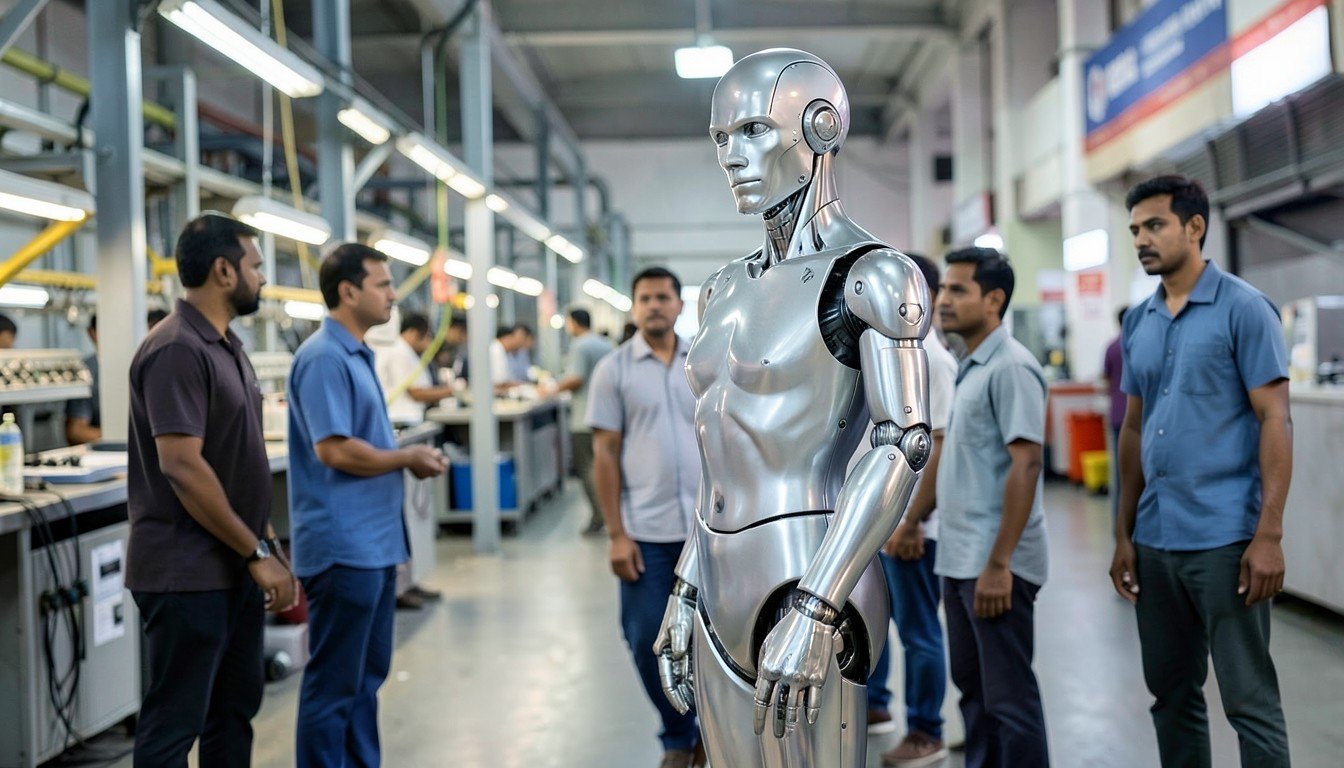
BYD’s humanoid prototype isn’t just a shell; it’s a 161 cm, 58.5 kg frame designed for actual work. While specific battery life specs remain under wraps, the robot uses 31 degrees of freedom (DOF) to manage balance and movement. Think of it like a high-end EV motor system condensed into a bipedal form. It relies on internal sensors to maintain equilibrium, which is essential if it’s going to move through a factory floor without tipping over.
The real magic is in the hands. With ±1 mm repetitive positioning accuracy, this bot is built for more than just waving hello. It can handle delicate object grasping and gesture-based interaction. The next frontier for AI is the physical world. Seeing this kind of precision in a machine prepped for dealership customer service is genuinely impressive.
Under the hood, the “Embodied AI” patent hints at an integrated stack focused on perception and real-time execution. BYD is clearly pulling from its experience in industrial automation and its partnerships with firms like Agibot. It isn’t just following a pre-coded script; it’s designed to process environmental cues on the fly. If you want to see how these machines eventually handle a tea tray or a car part, keep an eye on how they refine that decision-making engine.
Potential Indian Use‑Cases: From Factories to Living Rooms
In India, the most immediate impact of a machine like the BYD humanoid robot won’t be in your living room, but on the factory floor. With its 31 degrees of freedom and precise hand positioning, it is built for repetitive tasks. Think of a mid-sized automotive plant in Pune or Chennai; here, these robots could handle material logistics or assist human workers with quality inspection, significantly reducing physical strain during long shifts.
For homes, the potential is different. Given India’s changing demographics, elder-care monitoring—tracking movement or reminding someone to take their medication—is a logical fit. They could also act as interactive educational tutors for kids, moving beyond simple screen-based learning.
Public spaces might be the first time you actually interact with one. Imagine walking into a busy Bengaluru mall or an airport terminal and seeing a robot acting as an information kiosk. We have seen similar trials in Denmark, where robots successfully managed supermarket inventory and customer service. If they can handle that, guiding you to the right gate or store is a breeze. Just remember, a robot is only as good as the local data it is fed.
Cost Outlook: How Affordable Could a BYD Humanoid Be in India?
If you look at the price tags on heavyweights like Boston Dynamics’ Atlas, you’re easily looking at costs that would make an SME owner in Pune faint. Once you factor in international shipping, hefty import duties, and customs clearance for high-tech robotics, the final invoice often doubles. That just isn’t a sustainable model for our local factories.
However, BYD plays a different game. They disrupted the EV market by controlling the supply chain, and I suspect they’ll do the same here. Based on their aggressive EV pricing strategy, a realistic estimate for a BYD humanoid in India would likely fall between ₹3 million and ₹5 million. It’s still a premium purchase, but it moves from "research lab toy" to "functional factory asset."
Financing will be the key to widespread adoption. We’ll likely see "Robot-as-a-Service" leasing models for factories where the upfront capital hit is minimized. For healthcare or assistive tech, government subsidies could bridge the gap, similar to how we’re exploring India’s Path to Affordable Humanoid Robots with the New Open‑Source Biped. If you’re a business owner, start thinking about your ROI based on a three-year operational lifespan, not just the initial sticker price.
Regulatory and Safety Hurdles in the Indian Context
Before a BYD humanoid robot sets foot in an Indian showroom, it must clear the Bureau of Indian Standards (BIS) hurdles. We don’t have a dedicated humanoid certification yet, meaning BYD will likely need to align with machinery safety standards like ISO 10218 for industrial robots.
Safety isn’t just about avoiding bumps. Recent reports out of Germany, where a machine was seized after an alleged incident involving a young girl, prove that physical interaction requires strict fail-safes. If a robot malfunctions in a crowded Indian dealership, the liability chain is currently murky. BYD must clearly define whether the dealer or the manufacturer bears the brunt of legal accountability.
Data privacy is the other elephant in the room. Under India’s Digital Personal Data Protection Act, these robots—which are essentially cameras on wheels—must prove that they aren’t hoovering up customer face data without explicit consent. My advice? Don’t expect these machines to roam freely until BYD establishes clear, localized data processing protocols that satisfy Indian regulators. They need to show they can handle our chaotic, high-traffic spaces without causing a scene or a lawsuit.
Roadmap to Indian Availability: Timeline and Distribution Channels
Don’t expect these robots at your local store next week. Given BYD’s methodical approach to scaling its EV production, I would bet on an Indian debut between late 2026 and early 2027. They will likely start with controlled, high-value environments rather than a direct consumer rollout.
Distribution will probably mirror their automotive strategy. Expect to see them first within BYD’s existing Indian dealership network, acting as showroom assistants to explain vehicle features. From there, they will likely move through specialized robotics integrators who can handle the complex setup required for B2B clients. If you represent a large manufacturer, keep a close watch on pilot programs emerging in collaboration with major Indian research institutes. These partnerships are essential for refining the Google Gemini 4 Argon: India’s Next Robotics Boost integration that could eventually power these machines locally.
Here is how the rollout might look:
- Phase 1: Controlled pilot testing in BYD dealerships and select large-scale industrial factories.
- Phase 2: B2B sales via certified robotics integrators for warehouse and logistics automation.
- Phase 3: Limited, high-end consumer availability for niche residential and hospitality use.
My tip? If you are planning for this, start documenting your repetitive facility tasks now so you have clear data ready for integration partners when they arrive.
Practical Tips for Indian Buyers Considering a Humanoid Robot
Before you get excited about the latest BYD humanoid robot, pause. Do not buy one just because it looks cool. Start by writing down three specific, repetitive tasks you need automated—like sorting components in your warehouse or greeting visitors at your showroom. If the robot cannot handle at least two of these safely, save your money.
Serviceability is the biggest bottleneck in India. When you look at the recent design patent approvals, realize that hardware is only half the battle. Ask the vendor:
- Do you have a dedicated repair team within my state?
- What is the typical turnaround time for spare parts?
- Are software updates handled over the air or do I need an engineer on-site?
Finally, calculate your Total Cost of Ownership (TCO) beyond the initial price. Factor in electricity consumption, monthly maintenance contracts, and the cost of training your staff to supervise the unit. An idle robot is just an expensive piece of furniture. If you cannot find a clear ROI within 18 months, wait for the second or third generation. My advice? Start with a pilot project in one facility before scaling up.
Watch: BYD Reveals Its Own Humanoid Robot and wants to Make Millions of Them…
Frequently Asked Questions
When is BYD expected to launch its humanoid robot in India?
As of October 2026, there is no official timeline for an Indian debut. BYD is currently focusing its efforts on deploying these units within its own Chinese dealership network to handle customer service. Given the current focus on industrial testing and internal operations, it will likely be years before we see these walking into Indian living rooms or local car showrooms.
How much will a BYD humanoid robot cost for Indian buyers?
BYD has not announced any pricing, even in China. Estimating a rupee price is purely speculative right now. However, considering the high-end hardware like the 31-degree-of-freedom joints and precision hands, don’t expect a bargain bin price tag. If they do launch here, expect them to be priced as premium industrial equipment rather than affordable household consumer gadgets at first.
Can BYD’s robot be used safely in homes with children and elders?
While the robot is designed for interaction, safety remains a major open question. Recent headlines involving human-robot incidents abroad underscore why strict safety protocols are non-negotiable. Before you let one near your family, we need to see rigorous testing for collision avoidance and emergency stop features. For now, keep your expectations grounded; these machines are still in their experimental phases.
What Indian regulations apply to humanoid robots?
India’s current regulatory framework for robotics is still developing. We lack specific safety standards for autonomous humanoids operating in private spaces. As these machines arrive, the government will likely need to draft rules covering liability, data privacy, and physical safety. Until clear guidelines exist, companies will be responsible for setting their own self-regulatory benchmarks for user interaction and operational safety.
Is Your Living Room Ready for a 31-DOF Roommate?
Let’s be honest: having a 161 cm, 58.5 kg robot wandering around your house sounds like science fiction, but with BYD’s recent patent, it is moving into the realm of possibility. However, you shouldn’t clear space in your garage just yet. While those 31 degrees of freedom and the precision hand capable of ±1 mm accuracy are fantastic for factory work, our typical Indian homes are chaotic environments. Stairs, narrow corridors, and unpredictable power fluctuations are real hurdles for these machines.
If you are curious about how these devices might settle in, look at How Indians Might React to Humanoid Robots in Public Spaces for a reality check. My advice? Don’t hunt for a consumer model today. If you run a business, watch how BYD deploys these in their dealerships first. Keep an eye on their initial pilot programs; that is where the real-world testing happens.
Sources and further reading
- Chinese EV giant’s 31-joint humanoid robot could soon greet you at the car dealership — msn.com
- "Electric vehicles are next up for robots"… BYD suddenly unveils patent for its first in-house developed humanoid robot — starnewskorea.com
- BYD (01211.HK) Secures Approval for Design Patent on "Embodied Intelligent Robot" — news.futunn.com