Key takeaways
- Indian textile workers are already the hidden labor behind many AI vision models.
- Labeling pays more than floor‑wage work but creates a new dependency on AI that may later automate those jobs.
- Current AI policy drafts overlook gig‑type data workers, leaving them vulnerable.
- Learning basic annotation tools can future‑proof workers against displacement.
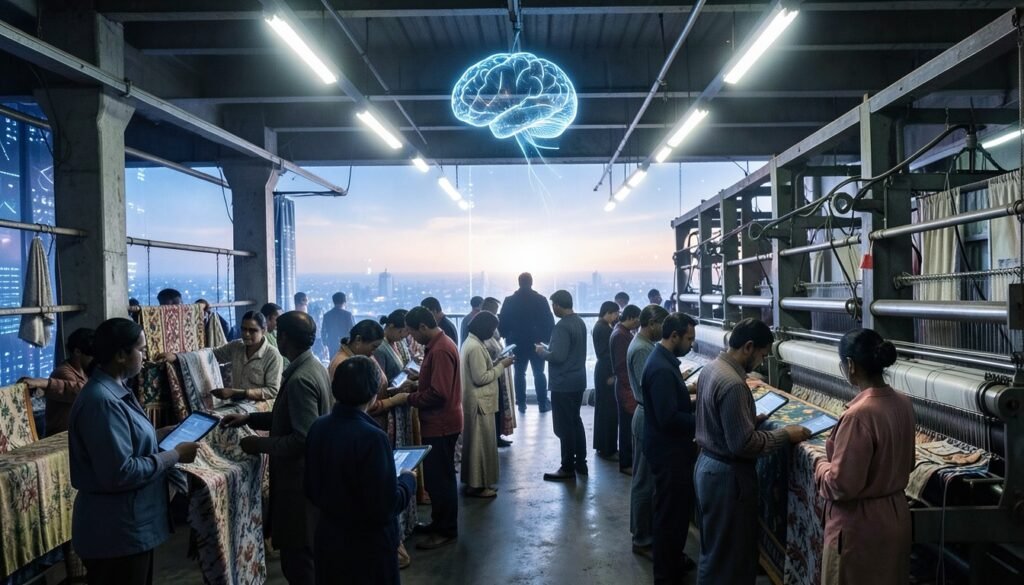
Imagine a worker in a textile mill in Tiruppur. After a ten-hour shift cutting fabric, they don’t go home to rest. Instead, they log into a platform to tag images of clothes, providing the essential AI training data India needs to feed hungry algorithms. It’s a strange irony: the very hands that once mastered the loom are now teaching machines to replicate their skills, often for a fraction of a living wage.
We are seeing a quiet shift where manual labor meets the digital gig economy. While some sectors like education are still debating the basics—as seen in recent reports on teacher adoption of AI—manufacturing workers are already deep in the trenches. This isn’t just about extra income; it’s about survival in an era of India’s AI Job Shock: 197 Million Workers at Risk. In this piece, we explore the human cost of this automation.
A Day on the Shop Floor – The Unexpected AI Classroom
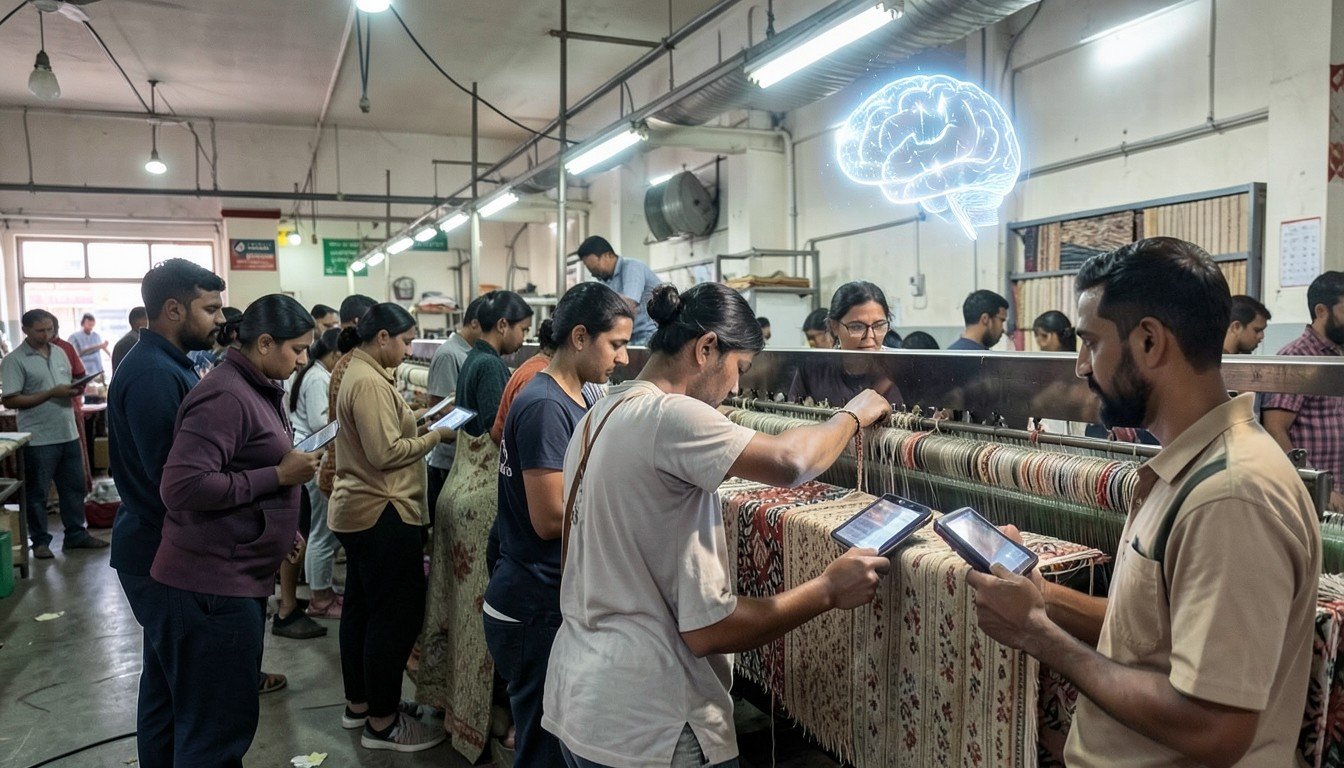
Imagine walking through a bustling textile mill in Gujarat. You expect the rhythmic hum of power looms, but instead, you find workers shifting from sewing machines to screens. They aren’t checking for loose threads anymore; they are tagging fabric defects for an AI startup.
According to an NPR report from October 2026, some of these workers are driven by the promise of steady income as traditional manufacturing fluctuates. They spend hours drawing boxes around fraying edges on digital images—a stark departure from the physical dexterity of stitching. One worker noted that while the screen work feels less taxing on the body, it is mentally repetitive compared to the tangible craft of weaving.
This shift is a strange irony. These laborers are effectively training algorithms to recognize patterns that might soon automate their original roles entirely. It mirrors the trend we’ve seen elsewhere, like How AI Is Squeezing Fresh Finance Grads in India, where high-skill roles face similar pressures. Unlike stitching, where the output is a finished garment, labeling data creates a digital shadow of their expertise. It is a precarious gig economy loop: you build the tool that replaces your yesterday to pay for your tomorrow.
Why Companies Need Human Eyes: The Data Bottleneck
Think of an AI model as a brilliant student that has never actually stepped outside. It can process petabytes of raw visual input, but without a human to point out a subtle defect in a textile weave or a flaw in a garment’s stitch, the machine is effectively blind. This "ground truth" is the rarest commodity in the industry today.
Industry estimates, such as those from McKinsey in 2023, suggest that data labeling is a massive cost center, often consuming a significant portion of total AI development budgets. As global capital floods into the sector, Reuters reports that this massive AI investment is fueling an insatiable demand for human labelers. Companies aren’t just looking for cheap labor; they are hunting for domain expertise—workers who can recognize a faulty loom or a thread irregularity before the software ever learns to.
But here is the rub. While thousands of workers—many of them women—are essential to creating these datasets, they remain locked in the lowest rungs of the professional ladder. As noted by newsbytesapp.com, women remain underrepresented in high-level AI design and technical roles in India. We are using their shop-floor expertise to build the future, yet we are failing to include them in the rooms where the actual architectural decisions happen.
The Economics of Labeling: Pay, Hours, and Upskilling
When you look at the ledger, the pivot to AI labeling seems enticing. Workers report earning between ₹150 and ₹250 per hour for annotating images—a significant jump from the daily minimum wages for textile laborers, which often fluctuate between ₹350 and ₹500 for a full eight-hour shift according to 2024 government figures. Effectively, labeling can offer double or triple the hourly rate found on a typical factory floor.
However, the "upskilling" promised by these platforms is often just learning to click and categorize. Companies frame this as a pathway to the digital economy, yet the actual certifications provided rarely hold weight outside specific data-labeling silos. It’s a classic gig-economy trap: you trade long-term stability for short-term cash, often without the benefits or job security you’d expect in a formal manufacturing role.
If you are wondering how this impacts the broader workforce, specifically regarding gender equity, it is worth looking at Will India’s AI Rules Save Jobs and Women? to see if the current regulatory climate offers any real protection. We aren’t just talking about higher hourly pay; we are talking about the long-term erosion of the skills that actually keep our industries running.
From Labeler to Displaced: The Double‑Edged Sword
It’s a cruel irony. You spend your shift labeling thousands of images of fabric weave flaws so that an AI can learn to identify them. The more accurate you make the model, the closer you get to being redundant. We aren’t just talking about abstract theory; I’ve seen early pilot projects in textile mills where cameras paired with machine learning now perform manual quality checks in seconds, effectively replacing the eagle-eyed workers who used to do it for years.
The IMF has aptly described this transition as a “slow-moving tsunami” for the global labor market, according to a 2026 Bloomberg report. When major players like HCLTech lean into AI msn.com to chase 7% to 10% higher margins, they aren’t just selling software; they are building systems that make human intervention a line item to be optimized away.
If you are currently working in a factory, consider this a warning: your expertise is being harvested to build your own replacement. When the model learns your workflow, the company’s incentive to keep you on the payroll drops significantly.
Regulatory Gaps and the Need for Protection
India’s approach to AI governance is at a crossroads, with the upcoming 2026 consultation by the government aiming to set the rules of the road (Indian Express, 2026). Yet, while lawmakers focus on high-level safety, there’s a deafening silence regarding the people actually powering these systems. We are seeing thousands of textile and factory workers transition into temporary data labeling roles, yet they remain outside any formal labor protection framework.
Current proposals fail to address the unique precarity of these gig-type data workers. If we don’t bake worker protections into our How India’s AI Regulation Will Shape Jobs, Ethics and Gender Equality framework, we are essentially building the future on a foundation of exploited labor.
To fix this, we need specific policy levers:
- Mandatory minimum wage floors for all annotation tasks.
- Portable benefits that follow workers across different labeling platforms.
- Clearly defined rights to collective bargaining for data annotators.
Without these, we risk creating a permanent class of "digital coolies." We need to ensure that the people teaching AI how to function aren’t treated as disposable hardware. It’s time we treated data labeling with the same regulatory seriousness as any other industrial labor.
Comparative Lens: China’s AI‑Linked Employment Initiative
In China, the government has moved to formalize its AI labor force. A Bloomberg report highlights how state-backed initiatives are establishing data annotation hubs in industrial regions, effectively transitioning factory workers into AI trainers. This isn’t just organic growth; it is a deliberate strategy to absorb labor displaced by automation into the digital supply chain.
India, by contrast, operates on a largely market-driven model. Our AI labeling sector relies on fragmented gig platforms where pay scales vary wildly and workers often lack institutional support or job security. While China builds state-sponsored "AI towns," our current approach leaves the heavy lifting of finding work and safety training entirely on the individual.
There is a clear lesson here for our policymakers. We cannot treat AI labor as just another gig task. As seen in the recent moneycontrol.com report on Karnataka’s teachers, even professional educators are struggling with a 38 percent gap in formal AI training. If we want to avoid creating a permanent underclass of data labelers, we need more than just market forces. We need state-led certification programs, standardized privacy protections, and a roadmap that treats these workers as critical infrastructure for our tech future.
Practical Steps for Workers and Unions
If you are a worker finding your factory floor tasks turning into AI labeling, stop and read the fine print. Don’t sign any contract that claims ownership of your "creative intuition" or future output. Unions need to push for clauses that guarantee retraining if your specific labeling role becomes automated, ensuring you aren’t just a temporary bridge for the technology that eventually replaces you.
For skill-building, look beyond the factory floor. Platforms like Amazon Mechanical Turk or local equivalents offer entry-level data tasks, but don’t stop there. You can experiment with technical concepts by learning to Build a Calculator, Graph & Game in ChatGPT with GPT‑6 UI to understand the logic behind the models you are feeding. Government-backed skill initiatives under the Skill India mission often have digital literacy components; check your local district center for updates.
Most importantly, keep a personal log of every hour spent labeling and the exact tasks performed. If you aren’t sure how to start, use a simple notebook or a note app on your phone. This data is your primary bargaining chip for future wage disputes or severance negotiations. When the machines eventually take over your specific labeling job, having a verified history of your work proves your value to the next employer.
What This Means for the Wider Indian Economy
The shift of textile workers into the AI data labeling economy isn’t just a niche trend; it’s a massive economic realignment. While official numbers are still catching up, some analysts suggest that millions of low-skill workers could transition into this gig-based data labeling role. This is an unconfirmed estimate, but the sheer size of India’s manufacturing workforce makes it a plausible reality.
According to a 2026 report by the World Bank, the integration of AI-enabled services is projected to provide a meaningful boost to India’s GDP. However, we must be careful. If this growth is built on the backs of underpaid, replaceable laborers, we are ignoring the structural risks. Furthermore, as noted by newsbytesapp.com, women remain significantly underrepresented in high-level AI design, which could worsen income inequality.
We are caught in a classic productivity trap. Companies want the efficiency that AI offers, but if we don’t protect the workers teaching these models, we risk creating a fragile economy. The real question is whether this digital labor will become a path to higher-value jobs or a permanent floor for the Indian workforce.
Frequently Asked Questions
How much do Indian data labelers earn per hour?
The provided materials don’t specify exact hourly earnings for data labelers in India. While we know that HCLTech expects AI-driven services to provide 7% to 10% higher margins than traditional IT work, this doesn’t directly translate to worker pay. Until more companies disclose their gig-worker compensation structure, any specific rupee figure remains unconfirmed and purely speculative.
Can AI labeling jobs replace traditional factory work?
It is a double-edged sword. An NPR report from October 2026 notes that textile workers are actively teaching AI how to perform their own tasks, but it is unclear if these labeling roles offer stable, long-term employment. These gigs often lack the benefits and security of formal manufacturing jobs, making them a risky trade-off for any worker.
What protections does the upcoming Indian AI regulation offer to gig workers?
As of now, there is no official document detailing specific legal protections for AI gig workers in India. Current policy discussions, such as the upcoming AI curriculum for schools, focus heavily on education and data privacy rather than labor rights. Without explicit government guidance, these workers currently operate in a regulatory vacuum with very little institutional safety net.
How does India’s AI data‑worker market compare with China’s?
The provided facts do not contain a comparative analysis between the Indian and Chinese AI labor markets. While both nations are pushing hard into AI development, we lack concrete data to draw a side-by-side comparison. Any claims about the scale or specific initiatives in China’s data-worker market remain unconfirmed within the scope of our current research.
A Future Built on Our Own Replacement
The shift isn’t just about labels; it’s about who owns the knowledge. When factory workers teach machines to recognize defects, they aren’t just earning a daily wage; they are effectively documenting themselves out of a role.
We’re seeing a classic automation trap. Big tech targets 7% to 10% higher margins on AI services, yet that wealth rarely trickles down to the shop floor. We risk building an efficient system that excludes the very people who built it. As we’ve explored in Why India’s AI Boom Is Leaving Women Behind, this threat is even sharper for our female workforce who often lack the institutional support to pivot.
If you’re in this industry, don’t just watch. Demand transparency—insist on data-labeling contracts that include genuine reskilling clauses. It’s time we treated digital data work with the same legal protections we expect for physical labor.
Sources and further reading
- Karnataka government-school teachers turn to AI, but training and data privacy gaps persist — moneycontrol.com
- HCLTech Goes Big On Claude, Plans First AI Data Centre With Sarvam — msn.com
- Women underrepresented in India’s AI design and development roles — newsbytesapp.com