Key takeaways
- Edge AI processes data locally on devices, reducing latency and reliance on stable internet.
- Hardware scarcity remains the primary bottleneck for scaling AI-powered solutions in India.
- Businesses must adopt a hybrid approach, balancing cloud-based power with edge-based speed and privacy.
- Government-led semiconductor initiatives are crucial for long-term self-reliance in AI hardware.
You might think AI happens entirely in the cloud, but the next massive hurdle for India’s digital future is sitting right on your desk. We are facing a critical shortage of specialized hardware, meaning the most innovative edge ai chip companies are struggling to get their tech into our local devices.
Software moves fast, but we currently lack an ecosystem to produce these processors at scale. As reported by thehindu.com, even giants like Amazon are fighting to break hardware lock-ins to lower costs. This shift is vital for the edge computing ai chip market, which dictates how efficiently devices process data locally.
I will break down who manufactures ai chips and why supply remains a bottleneck for us. Before we start, consider how data usage shifts when models aren’t cloud-dependent in our guide on What Is OpenAI Trained On? Why It Stopped Internet Training and What It Means for India. Let’s examine what company makes ai chips and what it takes for India to build its own.
What is Edge AI and Why It Matters
Edge AI is simple: instead of sending your data halfway across the world to a massive cloud server and waiting for a response, the processing happens right on your device. Whether it is a security camera in a Bengaluru apartment or a drone inspecting a crop field in rural Punjab, the AI lives locally.
Why does this shift matter? In India, network connectivity is not always reliable. Relying on remote data centers for real-time decisions—like an autonomous robot avoiding a collision—is a recipe for disaster when latency spikes. Moving intelligence to the "edge" cuts that wait time. It is about speed, privacy, and keeping your data where it belongs. As we discussed regarding Does OpenAI Use My Data for Training? What the New Shift Means for India, local processing is the ultimate safeguard.
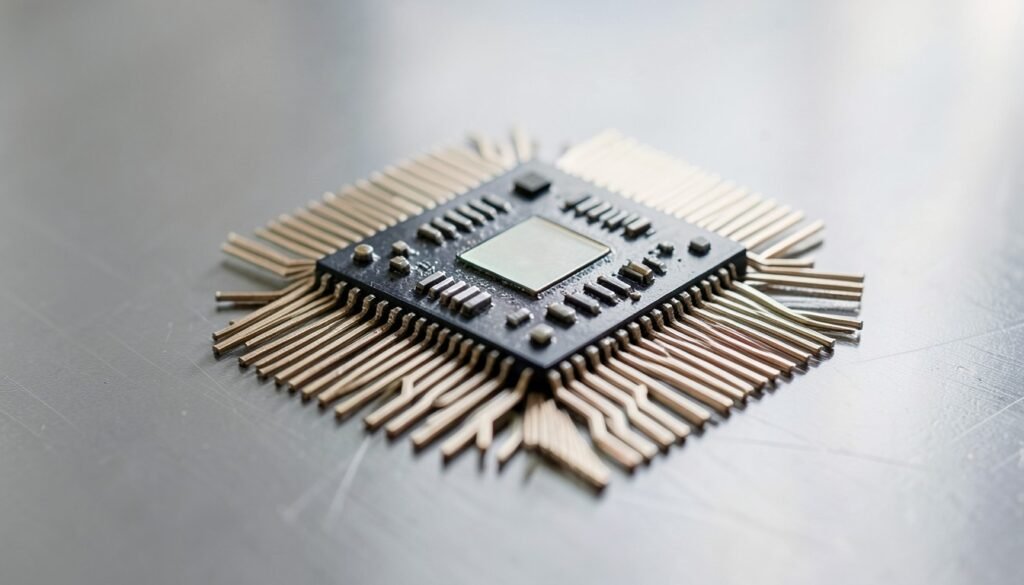
But you cannot do this with a standard CPU. General-purpose processors are like a jack-of-all-trades; they handle everything okay but are not built for the intense matrix math required by neural networks. Specialized Edge AI chips are different. They are hardware-optimized for inference. Think of them as dedicated power plants for AI, capable of running complex models on a fraction of the battery life. As more edge computing ai chip companies enter the fray, the race to build power-efficient hardware that does not overheat your phone or factory sensor is the real battleground for 2026 and beyond.
The Hardware Crunch: Why India is Struggling
India’s ambition to lead in AI is hitting a wall, and that wall is made of silicon. While we talk about large language models and software innovation, we are ignoring the harsh reality of the hardware supply chain. Most of the powerful Edge AI chips are designed abroad and manufactured in facilities far from our borders, leaving Indian startups at the mercy of global supply fluctuations.
The gap between what our developers need and what is actually available is widening. If you are a founder trying to deploy a computer vision model on a factory floor in Pune, you don’t just need software; you need hardware that can process data locally without a constant cloud connection. Right now, that hardware is either too expensive due to import duties or simply out of stock.
Global volatility means that when the semiconductor market hiccups, Indian procurement teams feel the flu. We are almost entirely dependent on imports, which forces smaller companies to compete with tech giants for limited batches of specialized silicon. Some local players are trying to change this; for instance, we’ve seen movement like Blue Cloud Softech Solutions Limited forming a joint venture specifically to build an edge-AI chip platform, as reported by indiatvnews.com.
Still, for the broader market of edge computing ai chip companies, the lack of local manufacturing remains a significant bottleneck. Until we fix our logistics and procurement strategies, building a product locally remains an expensive, uphill climb.

Consumer Electronics and the Edge Revolution
In India, the "AI" marketing sticker on your new smartphone often masks a reliance on cloud servers. We are seeing a shift where Edge AI chips are meant to handle tasks locally, promising better privacy. However, current consumer-grade silicon struggles with advanced large language models (LLMs). If you try to run a sophisticated model locally, your phone’s temperature spikes, and your battery life hits a cliff.
Thermal management remains the biggest hurdle for edge ai chip companies. When processors hit 45°C+, performance throttles, rendering your "AI assistant" sluggish. While we wonder Is AI Causing Layoffs in India? What Workers Should Know, the hardware reality is that we still lack the NPU density required for truly autonomous on-device processing.
When you buy your next device, look for these specs:
- Dedicated NPU TOPS (Tera Operations Per Second) rating—aim for 40+ for serious tasks.
- RAM capacity: 12GB or higher is now the baseline for local inference.
- Thermal design: Check if the device uses vapor chambers to dissipate heat.
The edge computing ai chip market is maturing, but for now, don’t expect your current smart home hub to run a full-scale LLM without crashing your Wi-Fi or your battery.
Industrial Applications: Manufacturing and Agriculture
In India’s sprawling industrial corridors, waiting for a cloud server to signal a defect on a production line is a luxury most SMEs cannot afford. Real-time quality control requires processing data exactly where it is captured. By moving inference to the factory floor, companies can catch microscopic errors in seconds, slashing waste and operational costs.
The same logic applies to our farms. For farmers in remote, low-connectivity regions, cloud-dependent AI is effectively useless. Local AI sensors—powered by specialized silicon—can analyze soil moisture or crop health directly in the field, ensuring precision agriculture without requiring 5G coverage in every acre.
However, the hardware must survive India’s reality. An office-grade processor will not last a week in a dusty, sweltering warehouse or a monsoon-drenched field. We need ruggedized components that handle extreme thermal swings and high humidity. Innovations like the Axera AX8860 edge AI chip series, which targets on-site large-model inference for robots and factories, show what is possible.
For SMEs, this is not just about high-tech; it is about survival. By adopting hardware from edge computing ai chip companies, a small manufacturer can monitor machinery health to prevent breakdowns, avoiding the massive downtime costs that often sink smaller players. Integrating these chips is the only way to make our manufacturing and agriculture competitive on a global scale. The bottleneck is not the software—it is getting the right, resilient hardware into the hands of those who need it most.
The Semiconductor Landscape in India
India is finally getting serious about silicon. Through the India Semiconductor Mission, the government is pouring billions into incentives to lure global players and support domestic firms. But designing a chip is not the same as printing one. While our local design houses are already churning out impressive custom AI-optimized silicon, the real hurdle remains mass manufacturing. We have the brains to design, but the foundry infrastructure is still catching up.
Think about the leap from a lab bench to a production line. Scaling from design to mass manufacturing requires massive capital and precise lithography tools that we are still assembling. For OpenAI AI Drug Discovery: What the Orchestra Bio Deal Means for India, local innovation is key, but it relies on hardware that works. To close this loop, universities are now partnering directly with firms to fast-track chip design talent. We are not just looking at who manufactures ai chips; we are looking at how we can own the stack. As we assess various edge ai chip companies, the focus must shift from pure assembly to proprietary IP. If we want to lead, we need to bridge the gap between silicon prototypes and the millions of units needed for our domestic edge computing ai chip market.
Edge AI vs. Cloud AI: A Strategic Comparison
Choosing between cloud and edge processing isn’t just about hardware; it’s about balancing physics and finance. Cloud AI excels at training massive models, but the latency involved in sending data to a server hundreds of kilometers away is a non-starter for mission-critical tasks. For autonomous drones or remote healthcare diagnostics, you need millisecond response times that only local processing provides. While cloud giants are making it easier to switch hardware—like the recent thehindu.com update to the AWS ecosystem—the cost of constant data transmission for high-bandwidth IoT sensors often far outweighs the initial investment in dedicated Edge AI chips.
Managing a single central server is straightforward, but overseeing a fleet of hundreds of edge devices is a logistical hurdle. You have to handle firmware updates, security patches, and physical maintenance across distributed locations. Here is how Indian enterprises are currently balancing these architectures:
- Data Pre-processing: Using edge chips to filter raw data locally, sending only critical anomalies to the cloud to save bandwidth.
- Hybrid Deployments: Keeping sensitive user information on-device while offloading heavy, non-time-sensitive computation to regional data centers.
- Latency Management: Hardcoding safety-critical functions on-device to ensure systems remain operational even when network connectivity drops.
Many Indian firms are adopting this hybrid strategy to mitigate risks. By balancing the raw power of the cloud with the immediacy of local hardware, they avoid vendor lock-in and keep long-term operational costs predictable. As more edge computing ai chip companies enter the market, these architectures are set to become the standard for our local manufacturing and retail sectors.
Security and Privacy at the Edge
Moving AI processing from the cloud to your device isn’t just about speed; it is a massive win for privacy. When your sensor or smartphone processes sensitive data locally, that information never touches a public network. This significantly shrinks your attack surface because there is no data stream for hackers to intercept. If you are curious about how these technical shifts impact professional roles, check out Is AI a Good Career in India? Anthropic’s Hiring Reality.
However, edge computing ai chip companies face a real headache: maintenance. Unlike a centralized cloud server that can be patched instantly, a fleet of edge devices in a remote factory requires complex, distributed firmware management. If a vulnerability is found, you cannot just click "update" once. You have to ensure thousands of individual units receive and verify the fix without disrupting operations.
For Indian businesses, this architecture is a godsend for data residency. Keeping data physically within the country’s borders, or better yet, locked inside the device, helps meet strict local compliance standards. But as we look at the edge computing ai chip market, the trade-off is clear: you gain sovereignty at the cost of operational simplicity.
Future Outlook: 2026-2030 Projections
Between now and 2030, the primary focus for edge ai chip companies will shift toward maximizing TOPS/watt. We are moving toward specialized silicon that handles heavy AI workloads without draining battery life or requiring active cooling, a necessity for the next generation of Indian smart devices.
Neuromorphic computing—hardware that mimics the human brain’s neural structure—will likely emerge as the gold standard for low-latency tasks. We are already seeing early indicators of this appetite in India, with firms forming strategic partnerships to build dedicated edge-AI platforms, as reported by indiatvnews.com. This local manufacturing push is critical to break our current reliance on costly imported silicon.
By 2030, the edge computing ai chip market will effectively define India’s digital backbone. If we successfully master the design of these processors, we stop being merely a consumer of foreign tech and become a hub for hardware innovation. Expect the next five years to be a race for local design talent and assembly capacity, shifting the power dynamic from centralized data centers to the devices in your pocket and on your factory floor.
Frequently Asked Questions
What is the difference between cloud AI and edge AI?
Cloud AI processes data in massive remote data centers, relying entirely on constant internet connectivity. Edge AI, however, processes data directly on the hardware—like your phone or a factory robot. It is the difference between sending a photo to a server miles away and having your device recognize your face instantly. Edge AI cuts latency, making it vital for real-time tasks.
Why are edge AI chips currently in short supply in India?
India faces a massive infrastructure bottleneck. While global edge computing ai chip companies are scaling, the domestic supply chain for high-performance silicon remains underdeveloped. We lack the local fabrication capacity found in Taiwan or the US, making us heavily dependent on imports. With global demand spiking for specialized chips, domestic manufacturers struggle to secure enough inventory to meet our growing local industrial needs.
Can my existing smartphone run advanced AI models locally?
It depends on your hardware. Most flagship smartphones today feature NPUs (Neural Processing Units) capable of basic edge AI tasks like live translation or photo enhancement. However, running large, complex models locally requires significant memory and specialized acceleration. If you have a device from the last two years, you might handle small models, but high-end generative AI still typically offloads to the cloud.
How does edge AI improve data privacy for Indian users?
Data privacy is a major concern in our digital-first economy. Cloud AI requires uploading your personal information to a server, creating a potential security risk. With edge AI, your sensitive data—like biometric logs or private documents—stays right on your device. By removing the need for constant cloud uploads, you drastically reduce the surface area for potential data breaches and unauthorized server-side access.
The Path Ahead: Why Edge AI Matters for India
Between 2026 and 2030, the real battle in India won’t just be about massive cloud capacity; it will be about how efficiently we process data locally. As we track the edge computing ai chip market, the primary hurdle remains hardware accessibility. While giants like Amazon are lowering the barrier to entry with tools like TorchNeuron to simplify switching between chips, local enterprises still face significant costs when trying to deploy on-device AI.
If you are building for scale, look at how firms are managing their infrastructure, like our piece on Google Gemini for Developers: Inside Cognizant’s 18,000 AI Agents. My advice? Stop waiting for high-end GPUs to become cheap. Start testing low-power inference chips today. The bottleneck is real, but the companies that master local processing will be the ones that actually survive our unique infrastructure challenges.
Sources and further reading
- Amazon targets Nvidia’s software edge with new AI tool — thehindu.com
- Axera Launches AX8860 Edge AI Chip Series — letsdatascience.com
- IT stock under Rs 50 gains as company forms JV for edge-AI chip platform: Check details — indiatvnews.com



Join the conversation