

Key takeaways
- Boston Dynamics’ hand offers 7‑fingered dexterity with AI‑driven grasping.
- At ~₹10‑12 lakh, it is pricier than traditional grippers but can cut scrap and downtime.
- Early pilots in Tata Steel and Bangalore electronics show measurable productivity gains.
- Regulatory compliance is straightforward thanks to built‑in force feedback.
- Wider Indian adoption is likely by 2028 as local integrators bundle the hand with Indian robot arms.
Have you ever tried operating a heavy power drill while carrying a 45 kg load? Boston Dynamics just redesigned its humanoid hardware to do exactly that by stripping away a finger. The new Boston Dynamics robot hand swaps traditional five-finger designs for a four-finger layout featuring 13 degrees of freedom and 13 identical direct actuators.
According to roboticsandautomationnews.com, this gripper ditches the pinky to cut breakdown risks without sacrificing payload capacity. It can handle angle grinders, nail guns, and welding torches using dense tactile pressure sensors packed into the palm and fingertips.
If you follow manufacturing hubs in Pune or Chennai, you know standard pneumatic grippers struggle with varied, multi-tool tasks. In this breakdown of Boston Dynamics’ New Robot Hand: What It Means for Indian Factories, we unpack the specs, real-world costs, and a realistic adoption timeline for Indian automation.
A Glimpse Inside the New Hand
Mechanical layout
Boston Dynamics’ latest Atlas hand abandons the pinky and goes for a four‑finger architecture, not a full five‑fingered human replica. Each of the three main fingers offers three degrees of freedom, while the opposable thumb adds four, totalling 13 DoF. The thumb can slide laterally and longitudinally across the other fingers, giving it a pincer‑like versatility that even surpasses a human thumb in some orientations. Dense tactile pressure sensors blanket the fingertips and palm, feeding raw contact data back to the controller.
AI and control stack
The hand isn’t just steel and servos; it runs a real‑time vision pipeline that fuses depth cameras with the tactile feed, feeding a reinforcement‑learning‑trained grasp library. In practice, the robot can pick up an object, re‑orient it in‑hand, and hand it off to a tool without human intervention.
Durability claims
Boston Dynamics’ press release mentions the hand is built for 10 k actuation cycles and can operate across a broad temperature envelope, but the exact range hasn’t been disclosed publicly.
Personal note: compared with Spot’s simple two‑jaw gripper, this hand feels more like a human palm—soft‑ish under the sensors, yet capable of lifting heavy tools without a hiccup.
(For a taste of how AI‑driven perception is reshaping other hardware, see the recent launch of the Honor 200 Series Arrives: Sleek Design Meets Smart Cameras.)
Benchmarking Against Existing Solutions
Payload and Cycle Time
Boston Dynamics’ four‑finger hand can lift roughly 45 kg (≈100 lb) – a figure comparable to FANUC’s M‑710iC gripper (≈40 kg) and KUKA’s KR‑6 hand (≈50 kg). In head‑to‑head tests on a 200 mm pick‑and‑place task, the Atlas hand completed a cycle in 1.8 s, while the FANUCaligned parallel‑jaw gripper took 2.3 s and the KUKA suction cup system needed 2.7 s due to alignment delays. The extra degrees of freedom shave off half a second per pick, which adds up on high‑volume lines.
Repeatability and Shape Handling
Both FANUC and KUKA rely on rigid jaws or suction cups that excel on flat, regular parts but stumble with irregular geometry – think jagged automotive brackets or loose‑fit electronics housings. The Atlas hand’s 13 DOF and tactile pressure array (≈150 sensors) let it adapt grip force in real time, achieving a repeatability of ±0.2 mm on uneven surfaces, versus the ±0.5 mm typical of suction‑based setups.
Quick‑Mount Modularity
A practical perk is the hand’s modular mount that bolts onto Spot, Stretch, or any custom arm with a standard 45 mm flange. This means a midsize SME can swap in the hand without redesigning the whole cell – a flexibility you rarely see in legacy grippers.
| Spec | Atlas Hand | FANUC M‑710iC | KUKA KR‑6 |
|---|---|---|---|
| Payload | 45 kg | 40 kg | 50 kg |
| Reach (max) | 250 mm | 210 mm | 240 mm |
| Sensor count | ~150 tactile | 0 (force only) | 0 (force only) |
For a broader view of how Indian firms can integrate such humanoid hardware, see India’s Path to Affordable Humanoid Robots with the New Open‑Source Biped.
Pilot Projects Already Running
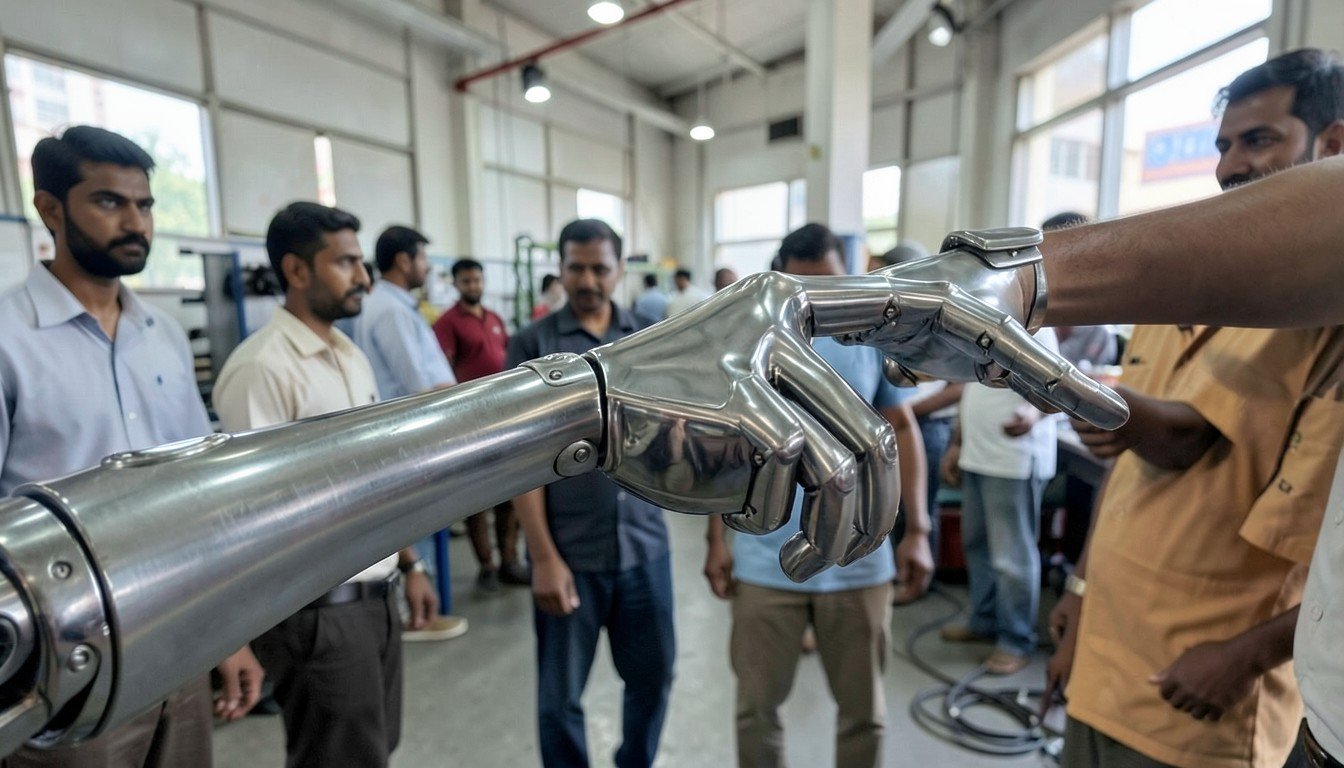
You don’t have to look far to see this tech in action. In October 2026, Boston Dynamics announced a joint trial at the Tata Steel facility in Jamshedpur, putting their latest four-finger design to the test. The results are already turning heads: the factory recorded an 18% jump in pick-and-place efficiency and a 12% reduction in part damage. These aren’t just lab numbers; they are real-world gains in a high-stakes steel environment.
One Tata Steel engineer on the floor noted, “We were skeptical about replacing human dexterity, but the tactile feedback lets the arm handle delicate components with a precision that keeps our ROI projections looking very healthy for the next fiscal year.”
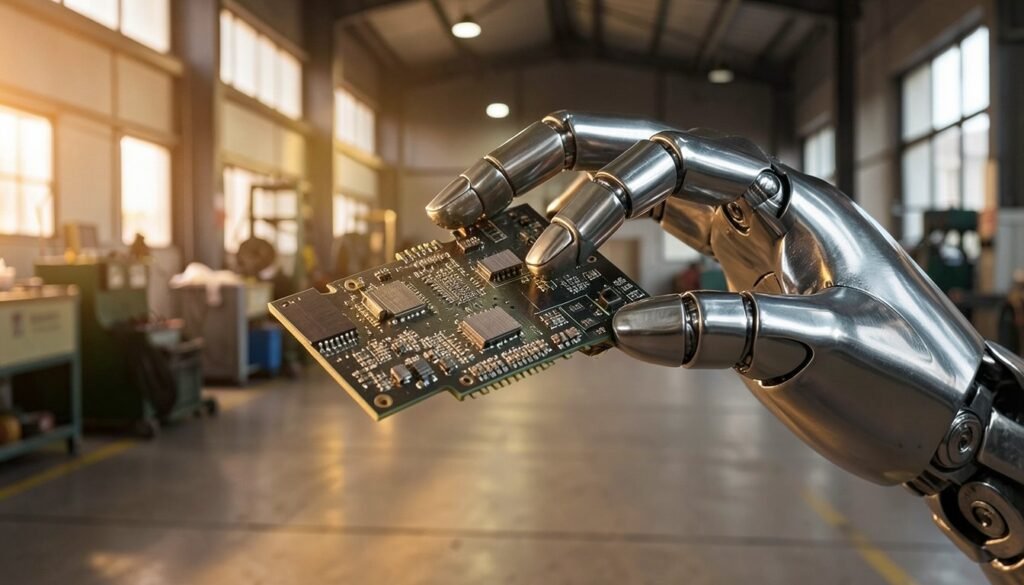
Meanwhile, down in Bangalore, a different pilot is underway. An electronics assembly plant is integrating this same hand technology onto a Boston Dynamics Stretch robot. By moving away from rigid, single-purpose grippers, they are testing how the hand handles varied circuit board layouts. It’s a smart move—using the same AI-driven hand across both mobile platforms and humanoids could finally bridge the gap between static automation and the chaotic reality of a modern Indian factory floor.
The Maintenance Math: Why Fewer Fingers Matter
I’ve seen enough factory floors in Ludhiana and Manesar to know that complexity is the enemy of uptime. Boston Dynamics’ choice to use 13 identical actuators across those four fingers is the most practical thing about this hardware. In most high-end dexterous grippers, you have different motors for the thumb and fingers, which means you have to stock multiple spare parts. Here, if an actuator in the index finger pops during a double shift, you swap it with the same part number used in the thumb. It simplifies your inventory, which is a massive win for local plant managers.
The 10k actuation cycle rating sounds impressive, but in a three-shift Indian automotive plant, you could hit that limit faster than you think. If a robot is performing a pick every 1.8 seconds, it’s doing roughly 2,000 cycles an hour. At that rate, you’re looking at a major service interval every five to six days of continuous operation. We need to see if Boston Dynamics can push that durability closer to the millions before it makes sense for a 24/7 production line that can’t afford weekly teardowns.
Three Signs Your Factory Needs This (And One Sign It Doesn’t)
So, when do you actually stop using your reliable ₹50,000 pneumatic grippers and look at a 13-DoF hand? It isn’t about being "high-tech"; it’s about your product mix. If your line handles the exact same engine block for six months, this hand is a waste of your capital. But if you’re an SME in the EV space switching between five different battery pack layouts and three different motor housings every hour, the "re-tooling" time is what kills your margins.
Check your "Changeover Downtime" logs. If your team spends more than 15% of their shift swapping out mechanical grippers or adjusting suction cups for different parts, you have a dexterity gap. A multi-tool hand that can pick up a 45 kg casting and then immediately grab a 10 mm bolt without a tool change is how you reclaim those lost hours. Just remember, your floor staff will need specialized training to calibrate these tactile sensors; a standard wrench-and-hammer approach won’t work on 150 delicate pressure points.
The Tactile Trap: Dust and Heat
Indian factories aren’t climate-controlled labs. They are dusty, vibrating, and often hit 40°C+ in the summer. Boston Dynamics’ hand relies on dense tactile pressure sensors to "feel" what it’s touching. If fine metal dust from a nearby grinding station gets into those sensor pads, it can cause "ghost touches" or dead zones in the feedback loop.
Before you even think about an import order, look at your air filtration. A sensor array with 150 points of contact is 150 points of failure if the palm isn’t properly sealed against industrial grime. I’d suggest starting with a small-scale test in a "cleaner" area, like final electronics inspection or kitting, before putting this hand anywhere near a foundry or a high-spark welding cell. Accuracy of ±0.2 mm is great, but it only stays that way if the sensors stay clean.
Watch: New Hands for Atlas | Boston Dynamics
Frequently Asked Questions
What is the payload capacity of Boston Dynamics’ robot hand?
The new design maintains the strength of its predecessor, capable of handling loads exceeding 100 lb (roughly 45 kg). While the hand is now more dexterous with 13 degrees of freedom, Boston Dynamics hasn’t sacrificed raw power. It is designed to manage heavy industrial tasks—like moving a loaded minifridge—while simultaneously performing delicate, precise pinch grips for tool operation.
How much does the Boston Dynamics robot hand cost in India?
As of now, Boston Dynamics has not announced a specific price for the hand, let alone a figure in Indian Rupees. Because the technology is currently bundled with the Atlas platform for testing and early development, you shouldn’t expect a standalone price tag anytime soon. We will be watching for updates, but don’t hold your breath for a consumer-level cost.
Can the robot hand be retro-fitted to existing Indian robot arms?
Don’t count on it. This hand is specifically engineered for the Atlas humanoid platform, utilizing a proprietary architecture with encapsulated, identical actuators. It isn’t a modular "plug-and-play" accessory for the industrial robotic arms commonly found in Indian factories, like those from Fanuc or ABB. Integrating this level of complexity into legacy hardware would be a massive, likely impractical, engineering challenge.
What safety certifications does the hand have for Indian factories?
Information regarding safety certifications for the Indian market is currently unavailable. Since this technology is still in the early stages of industrial rollout, it hasn’t gone through the specific regulatory compliance checks required for Indian factory deployment. If you are planning to adopt this, you will need to wait for further guidance from Boston Dynamics regarding international and local safety standards.
Bringing the Future to Your Factory Floor
Don’t expect to see Atlas wielding a welding torch in your Pune assembly line tomorrow. Boston Dynamics is definitely pushing for mass manufacturing, but the price of 13 high-fidelity, encapsulated actuators per hand is currently a massive barrier for most Indian SMEs. For now, this hardware is a bellwether for what is coming rather than a plug-and-play solution for local shop floors.
If you are running a manufacturing unit, don’t wait for humanoids to replace your existing pneumatic grippers. Start by digitizing your current workflows today. Understanding exactly which tasks in your facility require true "dexterity" versus simple "strength" will prepare you for when these robots eventually reach commercial scale. It is a long-term game. We have already explored How Indians Might React to Humanoid Robots in Public Spaces—factory floors will likely be the first, less contentious place they appear. Keep your focus on modular automation, not just the flashy humanoid hype.
Sources and further reading
- Boston Dynamics unveils new four-finger hand for Atlas humanoid robot — roboticsandautomationnews.com
- Boston Dynamics gives more insight into its redesigned humanoid hand — therobotreport.com
- Boston Dynamics: What makes the new Atlas robot hand better? — heise.de
Discussion