
Key takeaways
- Google has solved a 20-year-old error-correction bottleneck, making quantum calculations significantly more reliable.
- This breakthrough moves quantum computing closer to practical use in medicine and material science.
- Quantum computers will remain specialized, cloud-accessed tools for researchers rather than consumer devices.
- Indian research institutions must prioritize quantum algorithm training to remain competitive in global AI development.
Imagine you are trying to build a skyscraper, but four out of every thousand steel beams arrive shattered at the site. For twenty years, that is exactly how scientists felt trying to build a reliable quantum computer. The extreme fragility of qubits—the basic building blocks of these machines—has remained the single biggest hurdle in the field. However, Google’s latest Quantum AI research has finally cracked this code. By using a method called "magic state cultivation," they have reduced error rates by roughly 40 times, moving us away from purely theoretical physics toward actual, usable hardware. While we recently looked at how AI Models Flunk Self‑Research Test – What It Means for India, this hardware breakthrough suggests a future where compute power could eventually grow exponentially. Grab a cup of chai; let’s look at why this matters for India’s growing research community.
The 20-Year-Old Quantum Bottleneck
Imagine trying to balance a house of cards on a train track in the middle of a monsoon. That is essentially what physicists have been dealing with for two decades when trying to keep quantum computers running.
In your laptop, a bit is a simple light switch—it is either on or off. It is rock-solid and predictable. But a qubit? It exists in a quantum superposition, acting like a spinning coin that represents both 0 and 1 simultaneously. This state is incredibly fragile. The slightest whisper of thermal noise, a stray electromagnetic field, or even minor vibrations causes "decoherence," where the quantum information simply evaporates into static.
Since 2004, researchers have known that scaling these machines was a nightmare because of this inherent noise. We were not just fighting for raw processing speed; we were fighting for basic operational reliability. If a computer produces a wrong answer every few operations, it is useless for complex math. Think of it like buying the VLF Strada: Is This 250km Range Electric Scooter Worth ₹1.20 Lakh?—you need it to actually get you to your office, not break down halfway through the journey.
For twenty years, this specific bottleneck kept us trapped. We had the theory, but the physical hardware was too "noisy" to perform anything beyond trivial tasks. Solving this is not just about making a faster processor; it is about proving we can finally hold the "magic states" necessary to perform calculations that do not immediately collapse into garbage data.
How Google’s New Approach Works
To understand why the latest breakthrough on Google’s Willow processor is such a big deal, you first have to grasp the difference between physical and logical qubits. Think of physical qubits as raw, fragile hardware units that are incredibly prone to noise. On their own, they are unreliable. Logical qubits, however, group many physical units together to act as a single, stable, and error-corrected entity.
Historically, building these logical units required a massive, often exponential, increase in hardware. Imagine trying to send a large file over a terrible, static-filled internet connection; you might have to send the same data packet thousands of times just to ensure the recipient receives it correctly once. Google’s new approach introduces "magic state cultivation," which acts as a highly efficient filter for these errors.
This technique functions like an intelligent error-checker, identifying and discarding defective states before they compromise the entire computation. By applying this "horticulture-inspired" process, Google reduced the error rate from 4 per 1,000 to just 1 per 10,000. Essentially, they have found a way to "grow" high-quality, stable states rather than just throwing more physical hardware at the problem. This efficiency is exactly what India’s research sector needs to watch as we build our own expertise, including the recently approved Quantum-AI university in Amaravati. Instead of needing thousands of physical chips for one stable logical qubit, we are finally looking at a future where the math scales without breaking the budget.
Why Quantum Computers Are Currently ‘Noisy’
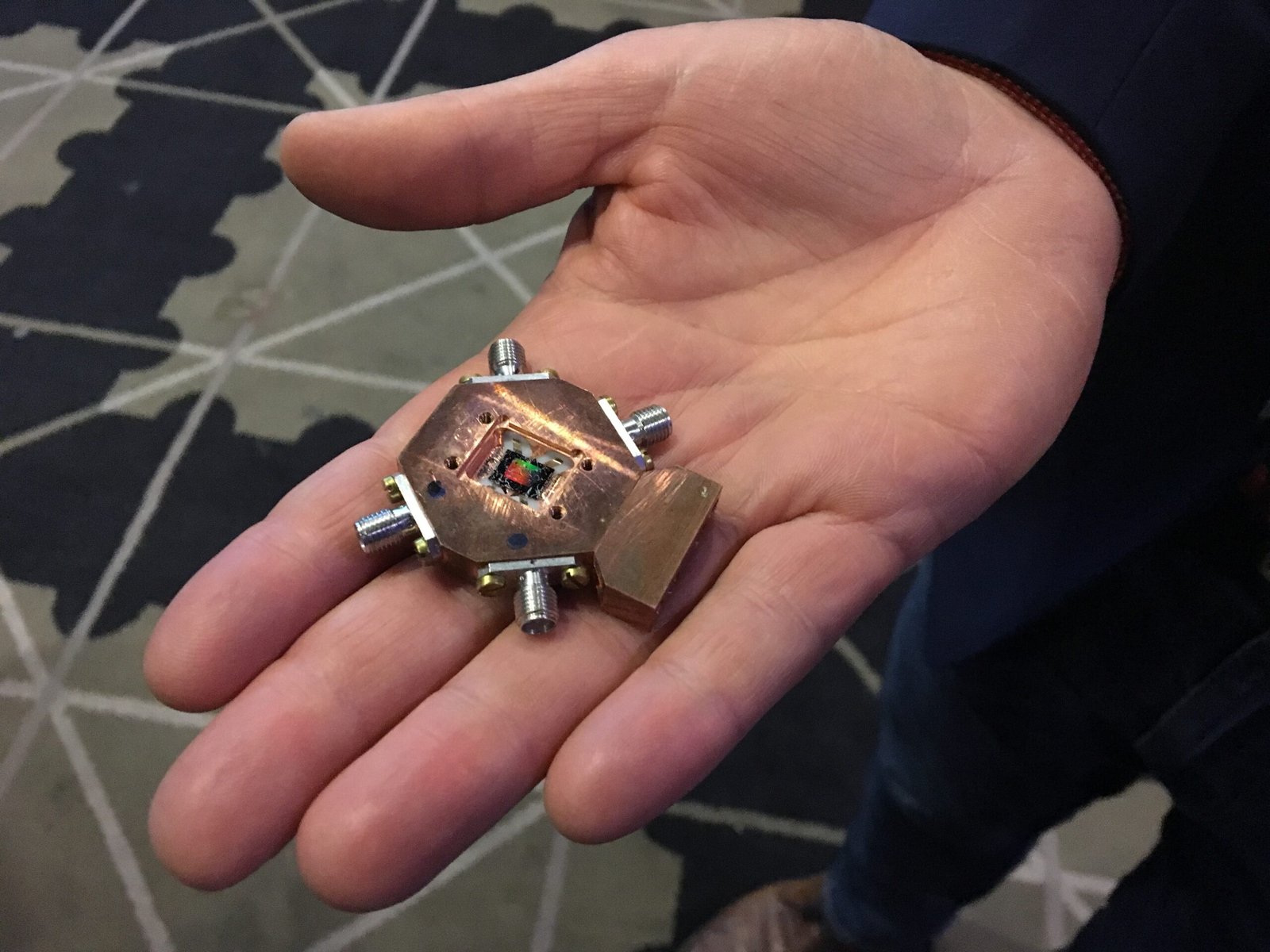
If your laptop’s CPU was a quantum processor, it would likely crash the moment you walked into a humid room. That’s because quantum computers are incredibly "noisy," a term scientists use to describe interference that ruins delicate quantum states. Even the tiniest rise in temperature or a stray electromagnetic pulse acts like a hurricane to these fragile qubits.
Think of it this way: your smartphone’s silicon chip handles billions of operations every second without skipping a beat because it uses stable electrical charges. It doesn’t care if the room is a bit warm. Quantum chips, however, perform calculations by maintaining superposition, a state that evaporates at the slightest touch of external heat or radiation. When these "noise" sources creep in, they corrupt the data, causing errors to stack up faster than the machine can solve them.
This is why current systems often fail before finishing a complex calculation. It’s like trying to build a house of cards during an earthquake. We are getting better at shielding these systems, but the sensitivity remains a massive hurdle. While we wait for hardware stability, software is already doing heavy lifting in other areas, like how AI Detects Heart‑Transplant Rejection Without Biopsy – What It Means for India. Unlike quantum systems, that AI runs on standard hardware because it doesn’t need to fight physical interference. For quantum researchers, the goal is to reach a point where the noise doesn’t outpace the computation. Until then, these machines remain laboratory curiosities rather than everyday office tools.
Real-World Impact: Beyond the Speed Hype
If you are tired of the hype cycle, you are not alone. When we talk about quantum computing, the real prize isn’t just faster browsing; it is solving problems that are currently invisible to our best supercomputers. As noted in recent reports on eu.36kr.com, Google’s progress with "magic state cultivation" is a scientific milestone, not a consumer upgrade.
Think about the chemical makeup of a high-capacity electric vehicle battery. Right now, simulating how atoms interact inside a battery is computationally exhausting. A quantum system mimics nature’s own quantum mechanics, allowing us to find stable, high-density materials that could make EVs cheaper for Indian consumers.
The same logic applies to drug discovery. Pharmaceutical companies spend years testing thousands of molecular combinations to treat a single disease. Quantum simulations could prune those possibilities, identifying successful candidates in a fraction of the time. Beyond the lab, we are looking at massive optimization challenges—like managing the energy grid of a city like Mumbai or Bengaluru—where billions of variables must be balanced simultaneously.
To be clear: you won’t see this in your smartphone next year. These are heavy-duty, industrial-scale scientific tools. They are designed for researchers, not for editing your office documents or gaming. If you’re a student or researcher in India, keep an eye on these developments; they are building the foundation for the next industrial shift, even if the hardware remains tucked away in specialized labs for now.
What This Means for India’s Research Sector
For researchers at institutions like IISc Bangalore or the IITs, this Google breakthrough is more than just a headline. It signals a shift from purely theoretical physics into the era of practical, error-corrected hardware. India has always been strong in algorithms, but we’ve lacked the physical machines to test them at scale.
Cloud-based access to these quantum processors changes everything. Instead of needing a multi-crore facility, an Indian researcher can now simulate or interact with these systems remotely. This is crucial for building the next generation of AI, much like when we analyzed Meta’s Muse Wonder: What Indian Users Need to Know. If our engineers can master quantum-ready code, we stop being just software service providers and start becoming hardware pioneers.
We need a massive push in specialized training. Quantum algorithms are not just faster versions of classical ones; they require a completely different way of thinking. Universities in Amaravati are already stepping up with dedicated campuses, but we need this curriculum in every major tech hub from Chennai to Pune.
The final piece is collaboration. By partnering with global labs, Indian research groups can focus on niche applications—like material science or complex logistics—where quantum error correction matters most. We don’t need to build a Willow processor from scratch to lead the world in its application. If we get the training right, the research output will follow.
Quantum AI vs. Classical AI: The Capability Shift
If you’ve ever trained a large language model, you know the pain of waiting hours for a GPU cluster to churn through data. Classical AI operates by crunching binary bits in a linear, albeit fast, fashion. It’s brilliant at prediction, but it struggles when the number of variables explodes beyond what silicon can handle.
Quantum AI flips the script using quantum parallelism. Instead of testing one solution at a time, a quantum processor explores a massive range of possibilities simultaneously by leveraging superposition. Think of it like searching for a needle in a haystack: classical computers check each stalk of hay one by one, while a quantum system essentially examines the entire stack at once.
This shift targets specific, high-intensity problems:
- Combinatorial Optimization: Solving logistics or complex routing patterns that currently overwhelm classical servers.
- Molecular Simulation: Modeling drug interactions at an atomic level, which is nearly impossible for even our best supercomputers.
- Advanced Model Training: Accelerating the training phase of AI models by processing massive datasets in parallel.
When will these worlds collide? We aren’t looking at a total replacement of classical systems soon. Instead, expect a hybrid future where quantum chips act as co-processors for the hardest math, as discussed on msn.com. Practical convergence likely won’t hit the mainstream until 2027 and beyond, once error rates stabilize and hardware scales effectively. For now, keep your GPUs running—they have a few more years of heavy lifting left.
Limitations: Why You Won’t See a Quantum Laptop Soon
If you are waiting for a quantum-powered MacBook, I have some bad news: it isn’t happening anytime soon. Current quantum processors, like Google’s Willow, operate at temperatures near absolute zero—that’s roughly -273 degrees Celsius. Maintaining this environment requires massive, room-sized dilution refrigerators that consume significant amounts of energy.
These machines are not personal computers; they are specialized scientific instruments. You cannot simply plug a quantum chip into your desk because the infrastructure needed to shield qubits from heat and electromagnetic noise is larger than a typical Indian apartment kitchen. The energy overhead is also staggering, as keeping a system stable is a constant, resource-heavy battle against decoherence.
Instead of imagining a quantum smartphone, think of these systems as centralized, high-performance engines. Just as we use cloud platforms for complex tasks—similar to How Google’s AI Tools Are Boosting Indian Farm Profits—you will access quantum power via the cloud. If you are a developer in Bangalore or Pune, you won’t own the hardware; you will rent time on a remote, chilled-to-the-bone processor.
My advice? Stop looking for hardware specs on a spec sheet. If you want to stay ahead, focus on learning quantum programming languages like Qiskit or Cirq. The innovation here isn’t about shrinking the machine; it’s about mastering the logic that runs on these distant, cold, and incredibly powerful monoliths.
The Road Ahead: 2027 and Beyond
Now that the 20-year bottleneck of magic state production is yielding, 2027 will mark a definitive pivot from pure lab experimentation to building fault-tolerant machines. Scaling this requires moving from a few dozen qubits to thousands capable of error-resilient computation. If you’re tracking this, look for how hardware manufacturers standardize these protocols globally, as inconsistent error-correction methods will only create isolated, incompatible systems that limit scientific progress.
We are shifting from theoretical models to practical utility. For India, this is critical. With the Andhra Pradesh government approving the state’s first Quantum-AI university, the focus is rightly shifting toward training the next generation of researchers who can implement these protocols in local infrastructure.
In the next few years, expect early pilots in high-stakes sectors:
- Logistics: Solving complex vehicle routing problems that current classical solvers struggle with.
- Finance: Running portfolio optimization models that account for thousands of variables simultaneously.
These won’t replace your laptop, but they will sit in specialized data centers. The goal for 2027 is clear: move beyond the "noisy" era. As we refine the "cultivation" process, we stop wasting 95% of our computing power on error correction. Instead, we start dedicating that energy to actual problem solving. It’s a slow, deliberate grind, but we are finally building the foundation for machines that don’t just calculate—they solve what was previously thought to be impossible.
Watch: Google’s Quantum Breakthrough Explained Simply
Frequently Asked Questions
Is quantum computing going to make my current laptop obsolete?
Don’t toss your laptop just yet. Quantum computers like Google’s Willow processor aren’t designed for browsing the web or drafting emails. They are specialized, massive machines kept at extreme sub-zero temperatures to function. Your current laptop will remain the standard for daily tasks for decades. Think of quantum systems as massive, specialized laboratories, not consumer devices you’ll find on a desk in Connaught Place.
How does error correction change the reliability of quantum results?
In the past, quantum computers were so "noisy" that results were often unreliable. By using magic state cultivation, Google reduced the error rate by 40 times—from 4 defects per 1,000 to just 1 per 10,000. This breakthrough, published in the journal Science, means we can finally trust the math coming out of these systems, allowing researchers to perform complex operations with 99.99% logical fidelity.
Can Indian researchers access these quantum computing tools today?
Direct access to proprietary hardware like the Willow processor is currently extremely restricted. However, India is ramping up its efforts. With the Andhra Pradesh government recently approving the country’s first dedicated Quantum and AI university in Amaravati, academic focus is shifting. While you cannot walk into a lab and use a quantum chip today, Indian researchers are increasingly gaining cloud access through strategic international collaborations.
What are the biggest barriers to scaling quantum AI research?
The main hurdle is the cost of "magic states." Currently, these building blocks are so rare that a system might spend 95% of its power just creating them, leaving almost no room for actual computation. Scaling requires us to make this production more efficient. Until we solve that, quantum AI remains trapped in the laboratory stage, far from large-scale, everyday commercial deployment.
Beyond the Hype: What Comes Next?
Don’t expect a quantum processor in your next laptop refresh. While Google’s breakthrough with "magic state cultivation" is a massive leap toward universal quantum computing, we are still in an experimental phase. The real work is moving from the lab to specialized research clusters, like the new Quantum-AI university campus in Amaravati, where the next generation of Indian talent will grapple with these error-correction hurdles.
Just as AI Research: Ending mRNA Vaccine Cold Storage Needs changed how we approach medical logistics, this quantum shift will eventually rewrite how we model complex molecular interactions. If you’re a student or a developer, my advice is to stop obsessing over "supremacy" buzzwords and start studying error-correction protocols. The future won’t be built on hype; it will be built on fixing these tiny, persistent machine errors.
Sources and further reading
- 20-year-old bottleneck solved: What Google Quantum AI’s latest scientific breakthrough means — msn.com
- Google, major breakthrough in quantum computing — eu.36kr.com
- AP approves India’s first Quantum-AI university in Amaravati; courses start this September — indianexpress.com