
Key takeaways
- Stop trying to fix bad results with better phrasing; start fixing them with better data.
- Structure your background information in machine-readable formats like JSON or Markdown.
- Treat your context library as a living project that requires regular updates.
- Prioritize quality over quantity; provide only the most relevant facts to avoid model confusion.
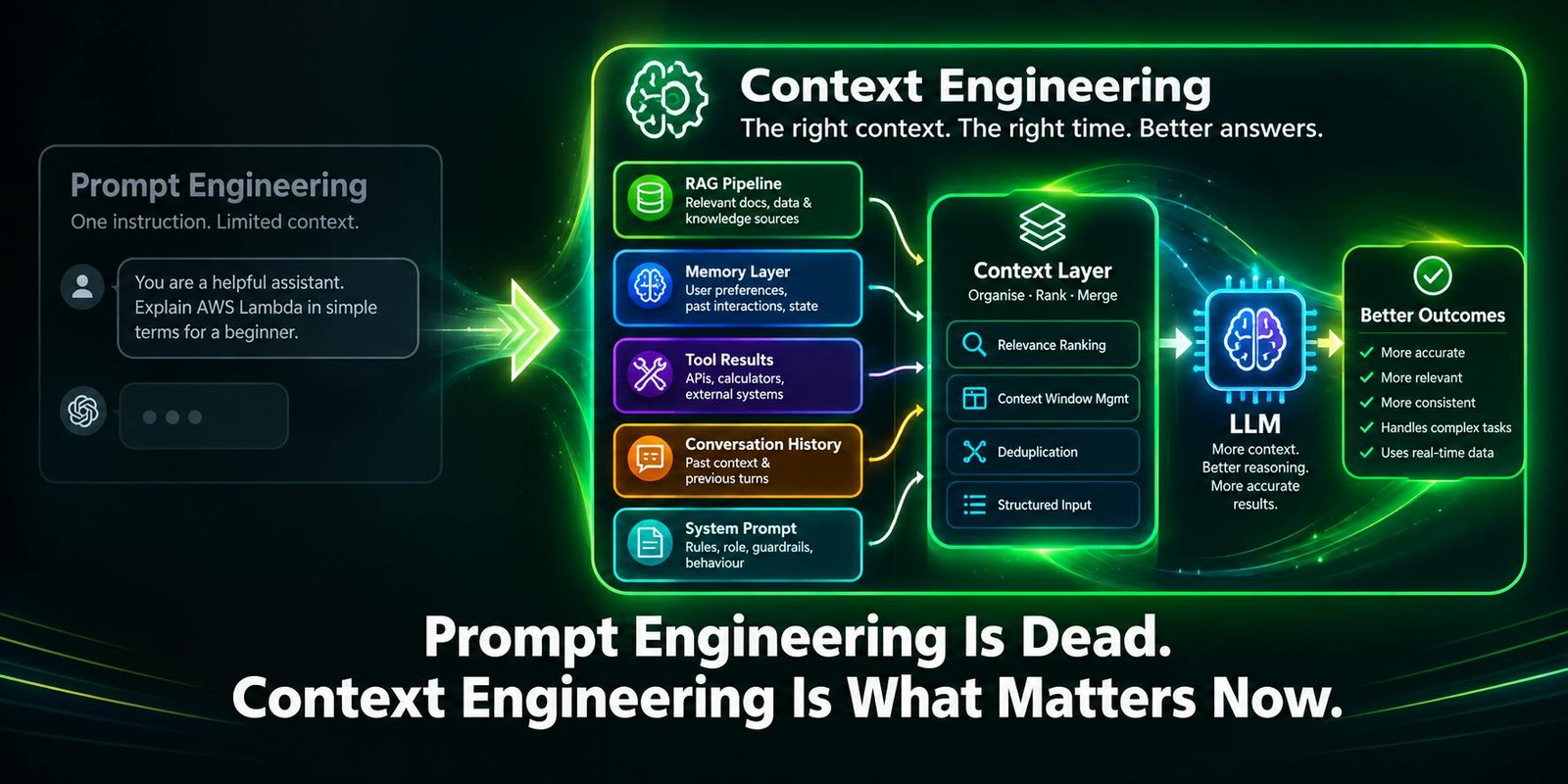
You’ve spent hours crafting the "perfect" prompt, only to watch the AI completely ignore your critical budget constraints. It’s frustrating, but if you’re still obsessing over your phrasing, you’re fighting the wrong battle. In 2026, the real bottleneck isn’t how you ask; it’s what the model actually knows when it answers. This is what is context engineering in ai, the discipline of designing the information environment for your model rather than just typing clever instructions.
While you might remember the basics from the What Is Prompting in Education? NCERT AI Curriculum Guide for Students, we’ve moved past simple incantations. As argued on hackernoon.com, the era of "magic prompts" is over. In this guide, I’ll show you how to stop babysitting your AI and start building structured, reliable context that actually delivers results.
What is Context Engineering?
If you’ve spent the last two years obsessing over "magic prompts" to get your AI to act right, it’s time for a reality check. What is context engineering in ai? It is the deliberate, tactical curation of the information you feed a model. While prompt engineering focuses on how you ask, context engineering focuses on what the AI actually knows before it starts typing. Understanding what is context engineering in llm workflows is the next step for anyone building serious applications.
Think of it this way: your prompt is the instruction manual, but the context is the library. Even if your manual is perfectly written, it is useless if the library is empty or disorganized. Many users fall into the trap of dumping raw, messy data into an LLM, hoping it’ll find the needle in the haystack. But LLMs have limited attention spans. When you flood the token window with irrelevant noise, the model loses the signal.
We see this in Indian startups where teams try to automate customer support using massive, uncleaned PDF archives. The model hallucinates because it can’t distinguish between a 2024 policy and a 2021 draft. You don’t need more "incantations"—clever phrasing meant to trick the model—you need structured facts.
Even if you use Production Grade Prompt Engineering: 5 Copy-Ready Templates, your results will plateau without proper context engineering. The difference is simple: prompt engineering is the polish, but context engineering is the foundation. Stop trying to outsmart the model with fancy words and start feeding it the specific, prioritized data it actually needs to deliver value.
The Shift from Prompting to Data Structuring
Back in 2023, we spent hours obsessing over the perfect persona or chain-of-thought instruction. We thought the magic was in the phrasing. But as we move into 2026, the real secret behind what is context engineering in ai is simple: stop explaining the task, start structuring the input.
If you dump a pile of raw, unformatted PDFs into an AI, you’re relying on the model to guess which sentence matters. It often fails, as noted on note.com, because models struggle to prioritize information buried in the middle of long, narrative blocks. This is the core of context engineering vs prompt engineering: you are no longer trying to trick the model with eloquent prose; you are curating its intake to make it impossible for the AI to ignore the signal.
Think of it like a filing system. Instead of writing a massive prompt, convert your messy project data into structured formats like Markdown tables, JSON, or CSV files. Adding specific metadata—like priority: high or deadline: Oct 30—acts like a signpost. It forces the model to weigh these points more heavily than the filler text.
- Before: A 500-word email chain where the client’s budget cut is buried in the fourth paragraph.
- After: A concise JSON block:
{ "client": "ACME Corp", "budget": "decreased", "pct_change": -20, "priority": 1 }
When you feed the model data this way, it stops guessing and starts processing. It shifts from being a vague creative writer to being a precise logic engine. You are building an information architecture.
Techniques: Building a Context Library
Think of your context library as a shared memory bank for your AI agents. Instead of pasting the same project constraints every time, store them as modular Markdown files in a private repository. I keep mine in a Git-tracked folder—it is the best way to version-control my style guides and technical requirement docs so the AI never relies on outdated specs.
When you need to generate a new report or debug code, you do not just fire a generic query; you pull the relevant "context module." For coding tasks, I often reference my specific Best AI Prompts for Intent-Based Programming: Build Apps with Natural Language alongside a project-tech-stack.md file.
Organizing Your Library
| File Type | Purpose | Update Cadence |
|---|---|---|
style-guide.md | Brand voice, tone | Monthly |
api-specs.json | Endpoint definitions | Per release |
project-scope.md | Current goals | Weekly |
To keep this updated without manual overhead, use simple automation scripts. If your team uses Notion or Obsidian, export your documentation to a standard folder and point your AI agent’s system instruction to watch that directory. This is how you implement context engineering effectively: stop treating the AI as an empty slate and start feeding it the exact, verified data it needs to succeed. By indexing your documentation with clear, descriptive headers, the model retrieves the right facts, not just the nearest ones. It makes the difference between a generic, hallucinated answer and a precise, actionable output.
Before vs. After: Context-Heavy vs. Prompt-Heavy
Think of the "Prompt-Heavy" approach as shouting instructions at a busy waiter. You’re repeating, "And remember, no cilantro! Also, make sure it’s spicy, but not too spicy!" The model gets confused by the noise. A "Before" prompt for a client proposal often looks like a 600-word essay trying to bake constraints into the instructions. It’s inefficient and prone to hallucinations because the core data is buried in the chatter.
Now, look at the "After" approach. You shift to a clean, modular structure.
| Approach | Prompt Length | Data Handling | Reliability |
|---|---|---|---|
| Prompt-Heavy | 500+ words | Embedded in prose | Low |
| Context-Heavy | 50 words | Structured block | High |
In the "After" scenario, your prompt is just: "Generate a summary based on the following context block." You then feed it a structured JSON object containing budget_limit: 50k_INR, client_priority: scalability, and tone: formal. By separating instructions from data, you stop asking the model to "find" the info and start giving it the info directly. As noted in yourstory.com, this deliberate design of inputs is exactly what is context engineering in ai.
The model performs better here because you aren’t forcing it to parse through your narrative fluff. It spends fewer tokens on interpretation and more on execution. When you treat data as a distinct layer, you stop fighting the LLM and start collaborating with it. This shift in context engineering vs prompt engineering is why your results become consistent.
Integrating Local Data: A Guide for Indian Businesses
If you are running an SME in India, you are likely sitting on a goldmine of unstructured data. Those piles of GST invoices, SOPs, and client lists are your biggest assets for getting accurate AI outputs. The secret isn’t just uploading files; it is about cleaning and indexing them so the model can actually parse the Indian context.
For example, when dealing with GST invoices, don’t just dump a raw PDF. Create a simple text-based summary of the invoice headers and key line items. If your business uses regional terminology for inventory or specific vendor codes, maintain a glossary file. Feed this to the AI alongside the document. It changes everything.
Privacy and Security
I get it—you’re worried about sensitive financial data leaking into public models. To keep things safe, avoid uploading raw, unredacted documents. Use local file systems to pre-process your data into anonymized chunks before sending them to an LLM. You can also explore local vector storage solutions that keep your core knowledge base on your own secure internal server. This way, the model only "sees" what you explicitly allow.
If you are scaling up, read our Claude AI for Indian Small Business: A Practical ROI Guide to see how others are handling this balance. By keeping your sensitive context local and only passing the necessary slices to the cloud, you maintain control without losing the efficiency of modern AI.
Tools for Managing Context: Vector DBs and Knowledge Bases
If you are tired of manually pasting PDFs into a chat window, it is time to upgrade your tech stack. When you ask what is context engineering in ai, the answer often boils down to how you effectively store and retrieve information at scale.
For smaller projects, a simple file-based knowledge base works fine. But if you are building an AI agent for your startup in Bangalore that needs to index thousands of past customer interactions, a vector database like Pinecone or ChromaDB is non-negotiable. These tools transform your messy documents into searchable numeric vectors, allowing the model to find specific answers in milliseconds.
The real power lies in retrieval-augmented generation. You do not dump your entire database into the prompt. Instead, your system performs a semantic search, retrieves only the most relevant three or four snippets, and injects them into the model’s window. As highlighted by hackernoon.com, the bottleneck in effective context engineering for ai agents has shifted from clever phrasing to the quality and relevance of the information provided.
For businesses handling sensitive financial or proprietary data, local LLM tools like Ollama or LM Studio offer a privacy-first approach. These allow you to run models on your own hardware, ensuring your context-rich environments stay strictly within your local network. It is the most reliable way to maintain data sovereignty while keeping your AI smart.
Common Pitfalls in Context Engineering
Even with a sharp strategy, you can easily trip up. Understanding what is context engineering in ai isn’t just about adding data; it’s about curation. The biggest mistake I see is "context bloat." Dumping every PDF in your Google Drive into an AI agent doesn’t make it smarter; it just buries the signal in noise. Models have limits, and stuffing them with irrelevant logs confuses the output. Think of it like cooking: adding every spice in your kitchen cabinet won’t make a better biryani.
Managing Conflicts and Decay
Conflicting data is another silent killer. If your internal policy document says one thing and a three-year-old email says another, the AI will likely hallucinate or pick the wrong one. You must enforce a strict hierarchy of truth. Furthermore, stale data is dangerous. Context engineering isn’t a "set it and forget it" task. You need a regular audit cycle, much like how you would compare Leonardo AI vs Midjourney: Which is Better for Your Art? to see which tool fits your current design workflow.
To improve, treat your context library like a living product. Test your outputs against specific edge cases every month. If the AI misses a nuance, strip away the junk and re-verify your source material.
Frequently Asked Questions
Is prompt engineering really dead?
It’s not dead, but it’s no longer the primary lever for high-quality performance. In 2023, tweaking words was everything because models were brittle. Today, models are much smarter at following instructions. The real bottleneck is no longer how you ask, but what data you provide. Focus on understanding what is context engineering in AI instead of obsessing over specific phrasing or "magic" words.
How is context engineering different from RAG?
Think of RAG (Retrieval-Augmented Generation) as the engine and context engineering as the fuel management system. RAG is the technical mechanism used to fetch data from your files. Context engineering is the strategic design of how that data is structured, prioritized, and presented to the model. You can have RAG running perfectly but still get poor answers if your context is poorly arranged.
Do I need a database to start using context engineering?
Not at all. You can start today by organizing your local documents. Use clear headers, categorize your inputs into premises and materials, and place critical constraints at the very beginning or end of your prompt. You don’t need a complex vector database to see improvements; simply being intentional about the order and relevance of your information is enough for most tasks.
How can I keep my sensitive business data private while using these techniques?
For Indian businesses handling proprietary data, look for enterprise-grade LLM deployments that offer data residency within India. Many cloud providers now support local data processing. Before uploading, sanitize your files by removing PII (Personally Identifiable Information). Always review your vendor’s privacy policy to ensure your documents aren’t used to train their public models. Privacy starts with being selective about what you share.
Stop Tinkering, Start Architecting
Stop obsessing over clever AI prompt templates. By the time you’ve spent an hour tweaking your phrasing, you could have properly structured your data, which is the real engine behind reliable AI output. If you want to understand what is context engineering in AI, think of it as building a library rather than writing a spell. You need to organize your facts so the model can retrieve them, much like how we look for specific technical specs in the Royal Enfield Flying Flea S6: What the Test Mules Reveal About India’s New Electric Bike.
My advice? Stop searching for the "magic prompt." Instead, audit your data. Pick one recurring business task, organize the necessary documents into a clear, prioritized sequence, and see if the AI’s accuracy improves. If your context is messy, your output will be too. Start small, structure your inputs, and watch the results.
Sources and further reading
- Prompt Engineering Is Dead. Context Engineering Is What Actually Matters Now. — hackernoon.com
- What is context engineering, and why it’s crucial for AI’s future — yourstory.com
- What is Context Engineering? | Why AI Answers Miss the Mark Even When You Provide Documents, and 4 Revisions You Can Make Today — note.com



Join the conversation