Intelligence that has to move
A robot must connect perception to action. It needs to understand its surroundings, choose a movement, and respond when the real world behaves differently from a simulation. Physical AI brings learning systems into that loop.
Why simulation matters
Training in simulated environments can expose machines to situations that would be slow, costly, or unsafe to reproduce repeatedly. NVIDIA’s robotics platform combines simulation and development tools for this work. Successful simulation still needs careful validation on real hardware.
What to watch
For every robotics announcement, look for the task performed, the operating conditions, and the amount of human intervention. Repeatable performance is more informative than a single striking clip.
A dance is a useful question, not a verdict
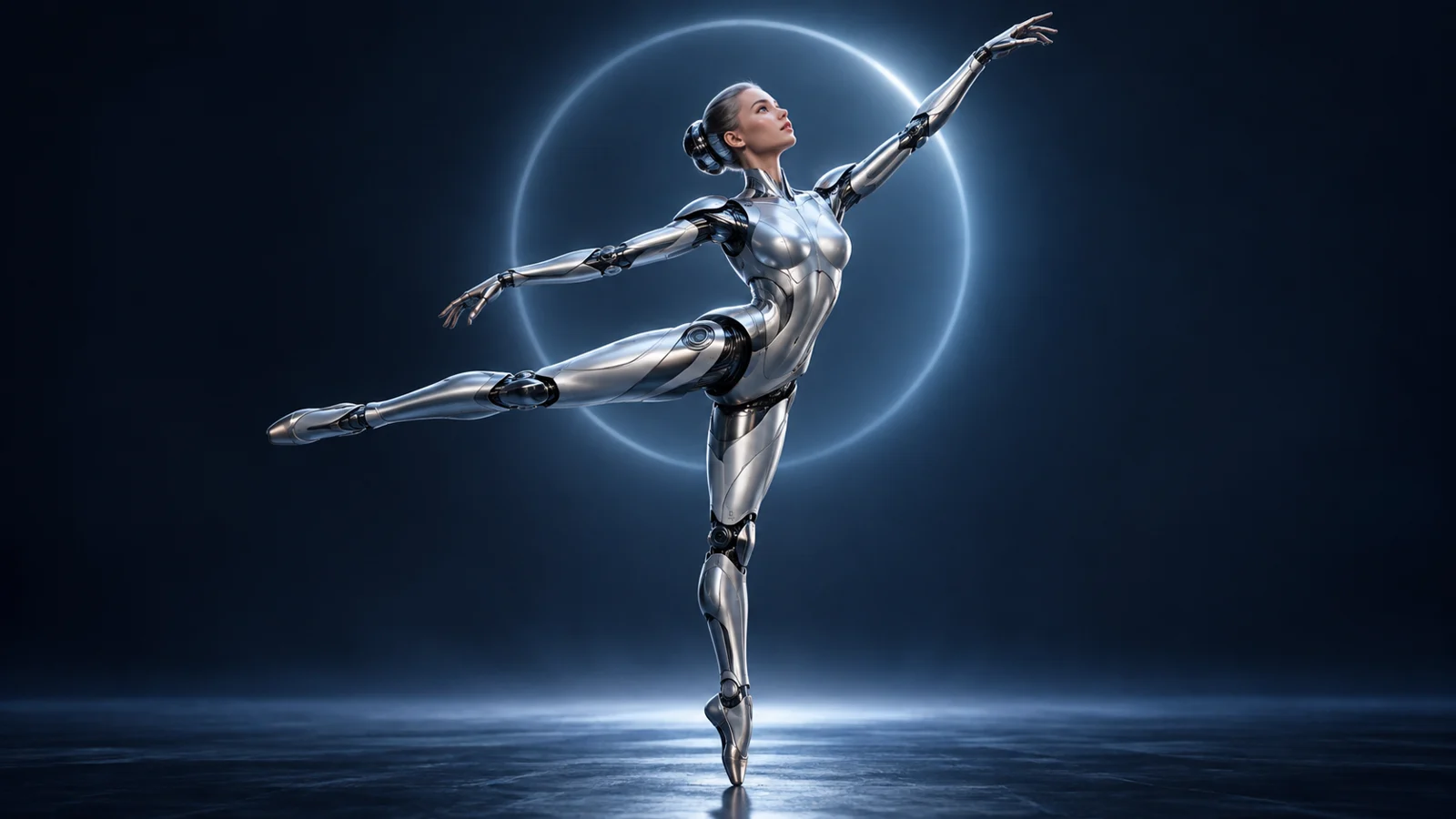
The robot on this page is an original animated concept. Its movements make coordination visible, but they are not a demonstration of a real machine or evidence of a product’s abilities. That distinction belongs beside any striking robotics visual.
A dance invites us to notice timing: the arms, torso and legs cannot be considered in isolation. When evaluating a real demonstration, however, the next questions concern the physical system, the setting, and the instructions behind what we see.
Look beyond the highlight reel
Our suggested viewing checklist starts with the complete attempt. Did the robot begin the task itself? Were objects arranged in advance? Did a person intervene? How many attempts were needed before the successful take?
These questions are not reasons to dismiss a demonstration. They help identify what it actually demonstrates. A carefully staged experiment can establish an important capability, provided its conditions are clear. Confusion starts when a narrow result is presented as a broad ability.
Ask what changes outside the lab
Consider a simple scenario: a machine moves an object from one marked location to another. Now imagine a different object, less predictable lighting, or a person crossing the workspace. Before drawing conclusions, look for evidence that covers those variations.
The same habit is useful when comparing announcements. A familiar humanoid shape can make two robots look comparable even when they are designed for different jobs. Start with the task and operating environment, then ask whether the published evidence addresses them.
What an informative robotics story includes
A good report should name the machine, describe the demonstrated task, identify the source of the footage, and explain what remains untested. It should keep simulation, remote operation, scripted motion and autonomous performance distinct.
That is the direction of our sample coverage: curiosity about what machines can do, combined with specific questions about how often, under which conditions, and with whose help.